


















Saudi Arabia’s rapidly evolving architectural landscape is creating new opportunities for materials capable of responding to demanding standards of design, durability and execution.
Within this context, Portuguese Natural Stone is consolidating its presence as a premium architectural material, supported by a long tradition of craftsmanship and by highly specialised industrial know-how.
Through the international project “Portuguese Stone – The Natural Path”, promoted by ANIET – the Portuguese Association of the Extractive and Processing Industry (co-financed by COMPETE 2030, Portugal 2030 and European Union) – Portugal is showcasing the diversity of its natural stones and, equally importantly, the technical capabilities of Portuguese suppliers in delivering bespoke solutions for complex architectural and interior design projects.
The strongest argument, however, lies in the work already completed in the Kingdom of Saudi Arabia.
Portuguese stone has been used in several Saudi projects where material quality, precision and visual impact were fundamental. Rosa Aurora marble, for example, was selected for the interiors of Saudi Royal Family palaces, including Al Yamamah Palace, demonstrating the suitability of Portuguese stone for interiors where refinement, exclusivity and material character are central to the architectural concept.
In Riyadh, the Ministry of Agriculture and Rural Affairs building incorporated approximately 5,000 sq m of Portuguese granite flooring. Beyond its visual presence, the application illustrates the capacity of Portuguese suppliers to respond to projects requiring consistency, resistance and dimensional accuracy across substantial surfaces.
At King Khalid International Airport, Portuguese stone was applied in a custom-cut geometric design, highlighting another defining feature of the Portuguese industry: the ability to move beyond standard formats and work closely with architects and specifiers on tailor-made solutions. Such projects demand not only the right material, but also high levels of digital processing, cutting precision, finishing quality and rigorous production control.
Scale is equally important. At the Jeddah station of the Makkah-Madinah High-Speed Railway, Portuguese suppliers participated in a project requiring approximately 170,000 sq m of high-resistance stone flooring. The project demonstrates the sector’s ability to combine large production capacity with the technical requirements associated with heavily used public infrastructure.
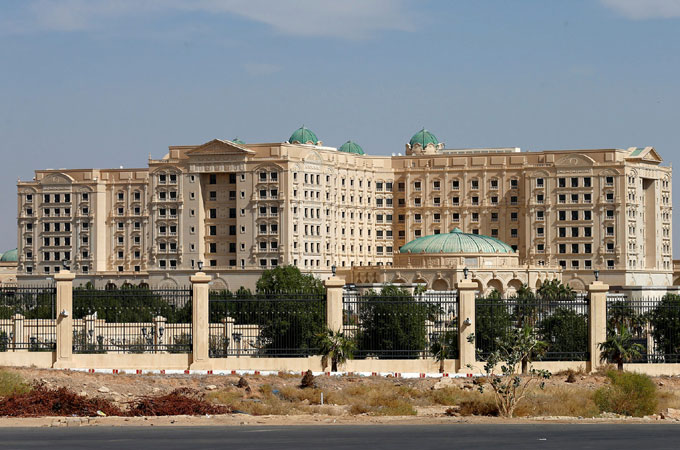
The luxury hospitality sector provides another significant reference. The Ritz-Carlton Riyadh features Portuguese Branco Nevada limestone on its exterior façades, placing Portuguese natural stone within one of the Kingdom’s most prestigious hospitality environments.
Together, these projects reveal the breadth of applications available to architects and interior designers. Portuguese natural stone can move from monumental flooring to façades, from bespoke geometric compositions to highly refined interior applications. Marble, limestone and granite each offer different aesthetic and technical properties, while a wide range of textures, finishes and formats allows the material to be adapted to contemporary, classical or highly customised design languages.
For premium projects, this flexibility is particularly relevant. Natural stone introduces depth, texture and individuality into architecture and interiors, with variations in colour, veining and mineral composition giving each application a distinctive identity. At the same time, the technical expertise of Portuguese manufacturers makes it possible to translate ambitious design concepts into precisely engineered components.
This combination of natural material and advanced processing is one of the key messages behind “Portuguese Stone – The Natural Path”. Rather than presenting stone simply as a commodity, the project promotes it as an architectural material supported by specialised knowledge, manufacturing reliability and the ability to respond to demanding international specifications.
As Saudi Arabia continues to invest in hospitality, cultural destinations, transport infrastructure and high-end real estate, the existing Portuguese references in the Kingdom provide architects, designers and developers with something particularly valuable: proven performance.
For Portuguese Natural Stone, Saudi Arabia is therefore not an untested destination. It is already a market where the material has been successfully applied in royal, governmental, transport and luxury hospitality projects – and where its combination of authenticity, durability and technical sophistication continues to offer strong possibilities for the next generation of landmark architecture. -TradeArabia News Service
• ANIET – Associação Nacional da Indústria Extrativa e Transformadora; Website: Projetos - Projeto SIAC Internacionalização