







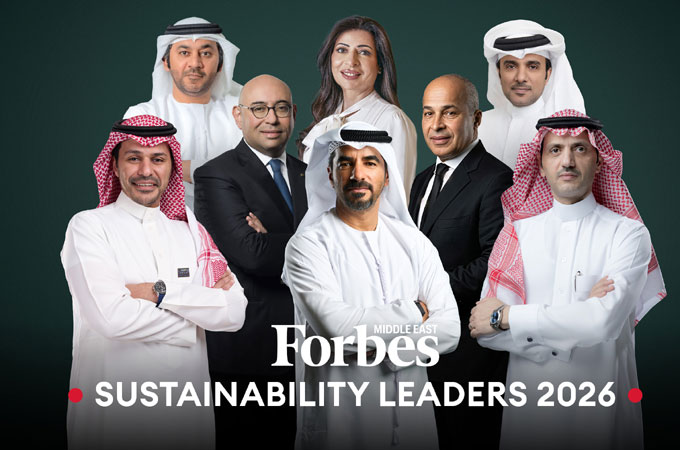
Forbes Middle East has unveiled the fourth edition of its annual ranking, The Middle East’s Sustainability Leaders 2026, recognising 145 executives advancing the region’s transition to a more sustainable, low-carbon economy.
Across major industries, they are accelerating decarbonisation, driving climate action, promoting innovation and shaping the region’s long-term sustainability agenda.
The list spans these 17 sectors - banks, development funds, energy and utilities, family businesses, financial services, food and agriculture, freezones, healthcare, investments and holding companies, manufacturing and industrials, oil and gas, real estate and construction, renewable energy, technology and telecom, transport and logistics, travel and tourism, and waste management.
The UAE-based firms lead with 75 entries, followed by Saudi Arabia with 29, and Qatar and Egypt with 14 each.
For this year’s ranking, Forbes Middle East reviewed questionnaires, sustainability and ESG reports, official disclosures and recent performance metrics to assess listees on their measurable ESG commitments, adoption of sustainable technology, and alignment with regional Net Zero targets.
Entries were ranked within each sector, with greater weight given to the measures most relevant to each sector.
Across the Middle East, companies are using automation and AI to improve resource efficiency, while extreme heat and water scarcity drive demand for efficient cooling, water reuse, and resilient food production.
According to International Renewable Energy Agency (Irena), renewable energy capacity across Arab countries grew 28.9% to 53.1 GW in 2025.
First Abu Dhabi Bank (FAB) mobilised $31.1 billion in sustainable and transition finance in 2025, reaching 76% of its $136 billion target. Masdar’s operating projects generated 40.2 TWh of clean electricity that year, and in July 2026, it reached financial close on a landmark $6.1 billion project combining 5.2 GW of solar capacity with 19 GWh of battery storage.
By June this year, Saudi Energy had connected 17.8 GW of renewable capacity to the national grid and energised 18 GWh of battery storage. In manufacturing, Emirates Global Aluminium (EGA) inaugurated the UAE’s largest aluminium recycling plant in 2026, lifting its total capacity above 400,000 tonnes annually.-TradeArabia News Service