
























































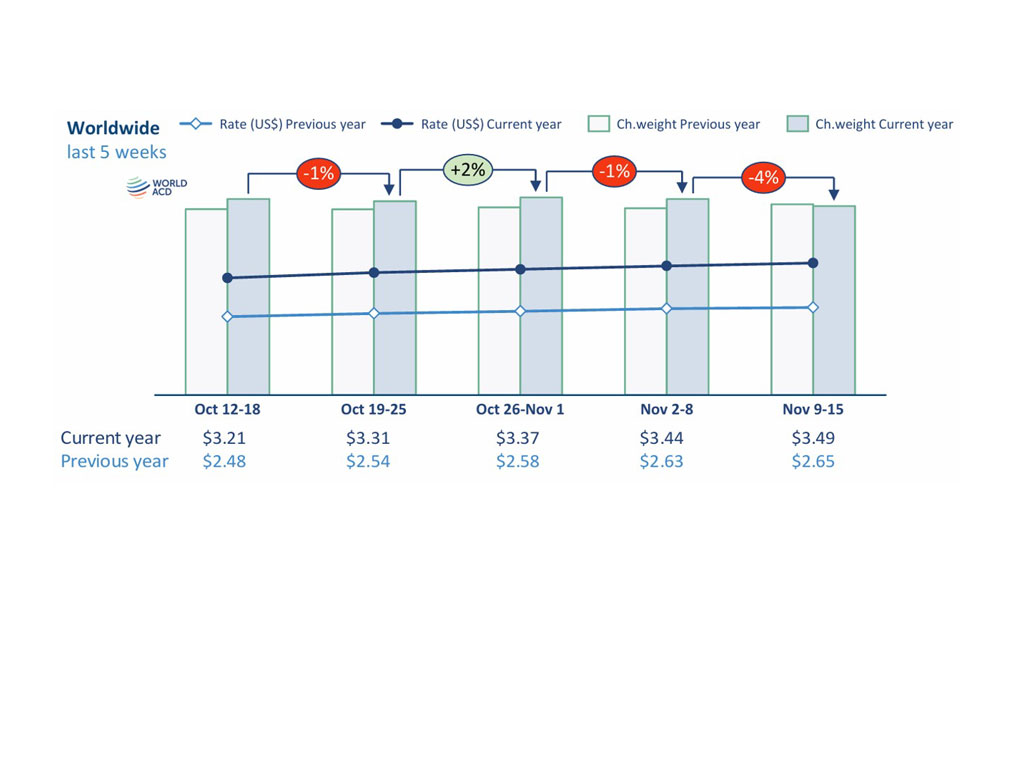
 WorldACD tonnage graph
The worldwide air cargo average rate in week 46 (November 9 to 15) rose by 2% to $3.49 over the previous week (WoW), stretching the increase in pricing to seven consecutive weeks, up from an average of $3.04 mid-September.
The upward rate momentum was aided by a -2% WoW decline in global capacity, while volume slipped -4% WoW, in part owing to the Diwali festival slowing exports from South Asia and the disruption of US flows from the outage of US aviation on November 13.
According to the latest weekly figures from WorldACD Market Data, rates dropped by -1% WoW out of Middle East & South Asia (MESA) and -2% from North America but climbed elsewhere. Rates from Central & South America (CSA) rose by 6%, the highest increase by origin region, followed by Africa (4%), while pricing from Asia Pacific and Europe inched up 2%.
Comparing the recent two weeks with the prior fortnight (2Wo2W), pricing was 4% higher overall, rising everywhere, again led by CSA (6%), followed by Asia Pacific and Europe with 4% higher rates.
Comparison with the same week last year (YoY) shows global pricing 32% higher, with the most pronounced increase from MESA (62%) and CSA showing the smallest rise (13%).
Capacity retreat aids rate rise
Global capacity shrank -2% WoW. While freighter lift slipped slightly, reduced bellyhold capacity was the main driver of the decline, falling for a third consecutive week. The decline was most pronounced out of North America (-8%), while MESA, Europe and Africa registered reductions of -1%, -2% and -3% respectively, and lift out of Asia Pacific was unchanged. Only CSA shows capacity expansion (3%), a result of shifting belly capacity from transatlantic to North America-CSA markets.
No sign yet of peak in chargeable weight
Chargeable weight dropped WoW out of all origin regions except CSA, which registered an increase of 6%. It fell -21% from MESA, followed by Europe (-6%), North America (-4%), Africa (-2%) and Asia Pacific (-1%). On a 2Wo2W basis, global tonnage declined -2%. Except North America, which shows no change, 2Wo2W volumes dropped everywhere, ranging from -1% (CSA and Asia Pacific) to -5% (MESA).
Volumes were affected by the outage of US air traffic control on Friday November 13, which not only paralyzed commercial flying in the US but also caused aviation authorities in Canada, Mexico and the European Union to halt all US-bound flights for the duration of the outage. During the following weekend, capacity on international flights from the US was still around -10% lower than the week before.
Overall chargeable weight was -1% lower compared to week 46 in 2025. It rose in low single digits out or Africa, Asia Pacific and North America, but declined -2% from Europe, -7% from CSA and -15% from MESA.
Volume up from Asia Pacific to US while tonnage to Europe dips again
Tonnage from Asia Pacific to USA partly recovered last week by 1% WoW, coming from a -3% WoW drop the week before. China, Hong Kong and Japan saw US-bound tonnage rise, while volumes were flat out of Thailand and Vietnam and declined out of Singapore (-10%), Taiwan (-6%), Malaysia (-5%) and South Korea (-1%). Indonesia showed the highest WoW increase (10%). Year on year US-bound exports from the region were 14% up, with Taiwan (32%) leading the charge, followed by South Korea and Vietnam (up more than 20%), while China, Japan, Thailand and Indonesia show growth over 10%. Only Singapore (-14%) and Malaysia (-2%) saw YoY a lower US-bound tonnage.
At the same time, after two weeks of flat growth chargeable weight from Asia Pacific to Europe dipped -1% on WoW declines from Malaysia, Hong Kong, Thailand, Vietnam and Japan. Tonnages were up between 3% and 5% from South Korea, Indonesia and Taiwan, while volumes from China and Singapore were flat. Year on year traffic was down -15%, marking a seventh consecutive week of double-digit decline, led by Hong Kong (-34%), followed by Thailand, Taiwan, China and Japan, which cancelled out gains from Malaysia, Singapore, South Korea and Vietnam.
Pricing up from Asia Pacific
Pricing from Asia Pacific rose 2% WoW to US and 4% to Europe. The rise in transpacific rates was driven by all origins except Indonesia (-3%), South Korea (-4%) and Taiwan (-8%). Year on year overall pricing remained over 40% higher, led by Singapore (86%), Japan (75%) and Malaysia (57%), the highest YoY increases in USA-bound pricing this year.
Rates from Asia Pacific to Europe slipped WoW in low single-digit percentages out of Malaysia and Singapore and were flat out of Thailand while rising from all other origins in the region. They rose 6% from China, followed by 4% increases from Hong Kong and Vietnam. Year on year pricing on the sector was 26% higher. Rates out of Indonesia, South Korea, Malaysia and Thailand were up nearly 50%, while China and Hong Kong increased by 16% and 18% respectively.
MESA volumes slump, pricing barely changed
Chargeable weight from MESA dropped -25% WoW to Europe and -23% to USA, a combination of the Diwali festival slowing down export activity from South Asia and the volatile situation in the Middle East. To Europe tonnage fell -27% from India, -29% from Sri Lanka and -17% from Bangladesh and (only) -3% from Dubai. Year on year tonnage on the sector was down -29% overall, with declines ranging from -13% from Bangladesh to -67% from Dubai. To USA tonnage out of Bangladesh and Sri Lanka grew WoW in low single digits but fell -22% from India and -40% from Dubai. Year on year MESA to USA tonnage was up 6%, fuelled by growth out of India (23%) and Bangladesh (38%).
Overall pricing from MESA to USA was unchanged WoW. It dropped -1% from India, cancelling out increases out of Dubai, Bangladesh and Sri Lanka (which saw rates jump 11%). The average rate from MESA to Europe retreated -1% WoW, with rates from the region’s origins mostly unchanged. Year on year pricing to Europe was 68% higher, with rates from India and Dubai up 76% and 97% respectively. To USA the average rate from MESA was 81% higher YoY, also driven by India and Dubai (both 88% up).
With peak season traffic expected to build up, upward pricing momentum should continue. The National Retail Federation revised its previous forecast for the peak shopping season upwards, projecting 4.2% growth in sales volume in the US. However, it noted that consumers have trended to start Christmas shopping earlier and predicted strong sales volumes over the upcoming Thanksgiving weekend - ahead of the onset of peak season airfreight volumes. Moreover, airlines have shifted capacity quickly in response to demand changes, in particular benefiting transpacific routes. These factors suggest relatively restrained rate increases.—TradeArabia News Service