The electronics industry is under increasing pressure to reduce its environmental footprint. As global demand for electronic devices continues to surge, so too does concern over the resources required to manufacture them and the growing mountain of e-waste generated at end-of-life.
New analysis from IDTechEx suggests additive manufacturing could slash emissions by up to 80 per cent and reduce water consumption by as much as 95 per cent compared with conventional electronics production methods. While the sustainability benefits are significant, the technology still faces major hurdles in cost, scale and performance before it can challenge established manufacturing processes.
Against this backdrop, additive manufacturing is attracting renewed attention as a potential game-changer. According to an analysis published by IDTechEx, additive manufacturing of electronic components could significantly reduce the consumption of materials, water and energy compared with certain conventional production processes. The findings suggest emissions reductions of around 80 per cent and water savings of up to 95 per cent, highlighting the technology’s potential role in enabling more sustainable electronics production.
The conclusions form part of IDTechEx’s latest study, Sustainable Electronics and Semiconductor Manufacturing 2027-2037: Markets, Technologies, Forecasts, which examines how manufacturers can reduce the environmental impact of electronics and semiconductor production while strengthening supply-chain resilience in an increasingly uncertain global landscape.
An Industry Facing Growing Sustainability Pressures
The sustainability challenge facing electronics manufacturers extends far beyond carbon emissions. Production processes consume vast quantities of raw materials, chemicals, energy and water, while end-of-life disposal remains a growing concern.
Global e-waste volumes are expected to exceed 96 million tonnes by 2037, creating mounting environmental and economic challenges. At the same time, the rapid expansion of AI infrastructure, electrification, connected devices and advanced manufacturing is placing unprecedented pressure on global supply chains and resource availability.
These trends are prompting manufacturers to re-evaluate traditional production methods and explore technologies that can improve efficiency while reducing environmental impacts.
Why Conventional Electronics Manufacturing Is So Resource Intensive
Much of today’s electronics manufacturing relies on subtractive production techniques. In printed circuit board (PCB) fabrication, manufacturers typically begin with copper-clad laminates before removing unwanted material through a series of etching, patterning and finishing processes.
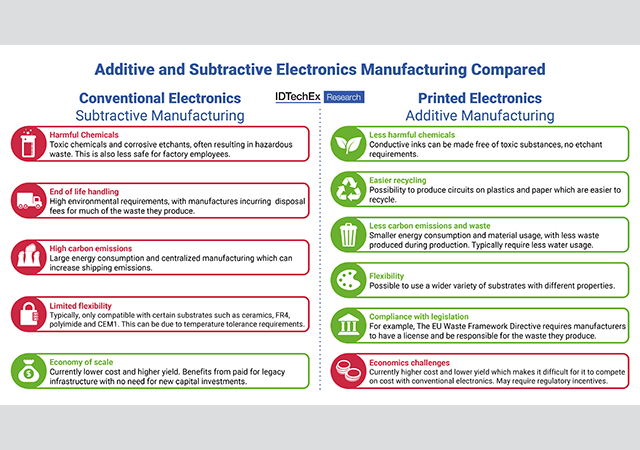
While highly mature and effective, these methods generate substantial waste. Significant quantities of copper are removed during production, while chemical etchants such as ammoniacal, ferric chloride and cupric chloride solutions are required to create circuit patterns. The process also consumes large amounts of water through repeated rinsing stages.
The result is a manufacturing model that has delivered remarkable performance and scale but comes with considerable environmental costs.
The Additive Advantage
Additive manufacturing takes a fundamentally different approach.
Rather than removing material, conductive inks and functional materials are deposited only where they are required. This minimises waste generation and reduces the need for many of the chemicals associated with conventional PCB manufacturing.
According to IDTechEx, this shift in production methodology is what underpins the potential for dramatic reductions in emissions and water consumption.
The sustainability benefits can extend beyond material efficiency alone. Introducing additive manufacturing often creates an opportunity to redesign production workflows from the ground up.
For example, manufacturers may be able to transition from expensive substrates such as polyimide to lower-cost alternatives like PET in certain applications. Many additive processes also operate at lower temperatures than conventional manufacturing methods, reducing energy consumption and lowering operating costs.
Taken together, these advantages make additive manufacturing an attractive proposition for companies seeking to align environmental objectives with commercial performance.
Sustainability Alone Is Not Enough
However, sustainability benefits do not automatically translate into market adoption.
According to interviews conducted by IDTechEx, customers in Europe and North America increasingly express interest in environmentally responsible manufacturing processes and products. Yet purchasing decisions remain heavily influenced by cost considerations.
For manufacturers, adopting additive production technologies often requires substantial investment in new equipment, process development and workforce training. This comes at a time when conventional electronics manufacturing has already benefited from decades of optimisation, creating highly efficient production ecosystems with established supply chains and significant economies of scale.
As a result, many companies remain reluctant to transition unless additive solutions can achieve cost parity with existing manufacturing methods.
Yield and Scale Remain Critical Hurdles
Beyond economics, manufacturing performance remains one of the most significant challenges facing additive electronics.
High-volume electronics markets demand exceptionally high yields to maintain profitability. While additive technologies have made substantial progress, many processes still struggle to match the consistency of traditional manufacturing.
Industry feedback cited by IDTechEx highlights the challenge. One printed electronics company reported yields of approximately 75 per cent, while established subtractive manufacturing processes commonly achieve yields closer to 96 per cent.
For manufacturers producing millions of components, this gap can have a major impact on overall production costs and competitiveness.
Complexity presents another obstacle. While additive manufacturing performs well for relatively simple circuit designs, producing sophisticated multilayer electronic assemblies remains more challenging than with conventional fabrication techniques.
Until these technical barriers are overcome, widespread adoption in mainstream consumer electronics is likely to remain limited.
Competing with a Moving Target
Additive manufacturing is not the only route to sustainability.
Traditional electronics manufacturing continues to evolve, with companies implementing more efficient chemical management systems, waste-reduction initiatives and resource recovery technologies.
Etchant regeneration systems, for example, help reduce chemical consumption and waste generation while improving overall process efficiency. At the same time, companies are developing innovative alternatives such as etchant-free metallisation processes for flexible PCBs.
This means additive manufacturing is not competing against static legacy technologies. Instead, it must demonstrate advantages over conventional methods that are themselves becoming increasingly sustainable and efficient.
Where Adoption Is Most Likely
Despite these challenges, additive electronics manufacturing is already finding opportunities in markets where its strengths align closely with customer requirements.
Applications such as RFID tags for smart packaging, wearable electronics, e-textiles, medical patches and disposable sensors are among the most promising. These products typically require simpler circuit architectures while placing greater emphasis on flexibility, lightweight construction and customisation.
Additive manufacturing is also proving valuable for rapid prototyping and low-volume production, where eliminating tooling requirements can shorten development cycles and accelerate innovation.
In these segments, the sustainability benefits are complemented by operational advantages that can justify adoption even before full cost parity is achieved.
By contrast, competing directly with conventional manufacturing in high-volume, multilayer consumer electronics remains a more distant prospect.
A Complementary, Not Replacement, Technology
The long-term future of electronics manufacturing is unlikely to be defined by a single technology.
Instead, additive manufacturing is expected to become part of a broader toolkit of sustainability-focused production approaches that includes improved conventional processes, advanced materials, resource recovery systems and new manufacturing architectures.
The technology’s ability to reduce emissions, conserve water and minimise material waste positions it as an important contributor to the industry’s sustainability ambitions. However, achieving broader adoption will depend on continued improvements in yield, scalability and cost competitiveness.
For now, additive manufacturing’s greatest opportunities lie in applications where sustainability, flexibility and customisation create genuine value. As environmental pressures and resource constraints continue to intensify, those niches could provide the foundation for a much larger role in the future of electronics manufacturing.