
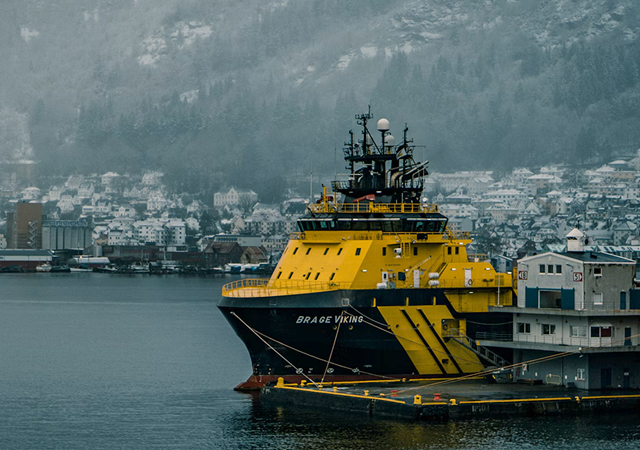
 Offshore support vessels play a critical role in supporting safe and efficient offshore operations.
Over the past decade, the offshore industry has digitalised faster than it has improved. Close to 5,000 suppliers now sell technology into the maritime market, and the average fleet runs a stack of tools that rarely interact with one another. Estimates vary by methodology, but it’s safe to say that a large share of the data offshore fleets collect goes unused.
At Opsealog, we’ve spent ten years working across more than 1,000 offshore support vessels, and the pattern we keep seeing is a shortage of decisions amid an abundance of data.
Most digital tools are deployed on the assumption that data will convert itself into action. In practice, a “conversion loop” is required, with someone accountable for reading the data, someone qualified to interpret it, and a mechanism that closes it back to the vessel. When any one of those three is missing, fleets end up with dashboards nobody owns and reports that never travel back to the people who filed them.
We call this the conversion gap, and it’s the subject of our latest whitepaper, The Conversion Gap: What Offshore Fleets Lose Between Data and Decision.

‘At Opsealog, we’ve spent ten years working across more than 1,000 offshore support vessels, and the pattern we keep seeing is a shortage of decisions amid an abundance of data’ – Arnaud Dianoux
Analysts are pointing the same way. At the 2024 Gartner Data and Analytics Summit, the message to asset-intensive industries was to stop judging systems by architecture and data volume, and start judging them by decision quality. The standard is that a system justifies its purpose at the exact moment a decision must be made. Measured against that standard, the same breakdowns repeat across the sector. Reports get filed because the contract requires it, but nothing returns to the vessel, so quality drifts. Dashboards display consumption and emissions to everyone, which in practice means to no one, because no single person has been made accountable for acting on the number. And vessels still carry more data on the bridge than the ecosystem can use. It rarely travels between the engine makers, equipment suppliers, software providers and operators who could all gain from sharing it.
Proof From the Field
The scale of what closing that gap can deliver is best shown through our own work. On the MV Flat Confidence, a Ghanaian-owned Anchor Handling Tug Supply vessel operating under a long-term Tullow Ghana contract, a year of structured fuel monitoring saved 732.6 m³ of fuel and 1,984 tonnes of CO2, worth close to $850,000 at current fuel prices in Ghana. Applied across a 24-vessel mixed fleet off Angola over six months, the same method saved 1,108 m³ of fuel and 3,055 tonnes of CO2, worth roughly $1.85 million at current fuel prices in Angola.
These results, in both cases, aren’t the product of any new hardware or system. They were achieved through an intentional change to who was reading the numbers and when, combined with a detailed comparison of each vessel’s fuel consumption against its sister ships. That comparison was then turned into specific recommendations, built with the crew so they fit how the vessel actually operated.
The value isn’t only in fuel and CO2, either. On one platform supply vessel, the data was right but the decision still stalled. The crew was caught between the rig’s instructions and the shipowner’s procedures – two sets of orders pulling in opposite directions. The master held position and prioritised safety, which was the correct call. It took the charterer, shipowner and crew sitting down together to read the same figures at the same time and work through months of contradictions in one conversation. Monthly fuel savings on the vessel went from 13.5 m³ in February to 51.2 m³ in May. The data didn’t change. Who read it, and who acted on it together, did.
The Convergence of Cost and Compliance
Regulation is accelerating this shift, but it isn’t the only driver. In Europe, the EU’s monitoring, reporting and verification rules already cover offshore vessels of 400 gross tonnage and above, and proposals published in July 2026 would extend the EU Emissions Trading System to smaller offshore vessels from 2031. Norway has gone further, confirming staged greenhouse gas intensity cuts for vessels operating on its continental shelf from 2029. Similar expectations are building outside of Europe too.
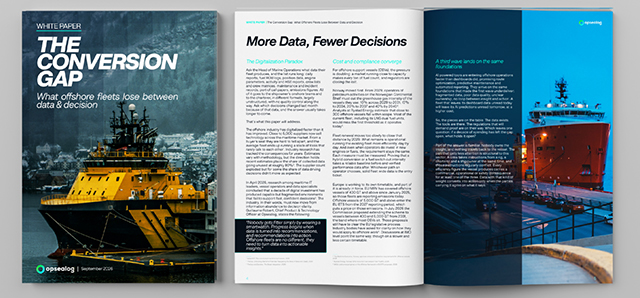
Opsealog’s new whitepaper explores the “conversion gap” between operational data and decision-making across offshore fleets.
Adnoc’s own net-zero programme is increasingly shaping how fleet performance is measured across its logistics operations, and in February 2026 we renewed a five-year collaboration with Adnoc Logistics & Services to scale digital performance management across one of the world’s largest offshore support vessel (OSV) fleets.
That programme now covers more than 100 OSVs, with reported savings above 20,400 m³ of fuel and 55,600 tonnes of CO2. It shows what sustained, fleet-wide monitoring can deliver, and it points to the other driver behind this shift. Fuel cost remains the most immediate commercial incentive, because every reduction in unnecessary consumption lowers operating expenditure and emissions at the same time. For operators in the region, performance data is a commercial tool as much as a compliance one.
The Gulf is well placed to lead on this. The GCC is a major offshore region, with high activity levels across several countries and many operators, all looking to improve operational efficiency, reduce risk and cost, and get more value from their operations. We see GCC players as among the most advanced in the industry. They tend to have a clear and ambitious vision and to provide the resources needed to deliver it and are in a strong position to keep acting as pioneers when it comes to data analytics and AI.
A Third Wave, Same Foundations
AI-powered tools are now entering offshore operations faster than dashboards did, promising route optimisation, predictive maintenance and automated reporting. They arrive on the same foundations that made the first wave of digital tools underdeliver, including fragmented data, unclear ownership and no loop between insight and action. A fleet that leaves its dashboard data unread today will leave its AI predictions unread tomorrow, at a higher cost.
None of that makes AI the problem. Used well, it will speed up the shift from descriptive reporting to predictive and prescriptive decision-making, especially for companies that already have solid data management foundations and in-house expertise. Much of the value will come from history. Years of well-documented operational decisions, and what followed from them, are what allow models to anticipate issues and recommend actions rather than simply report what has already happened.
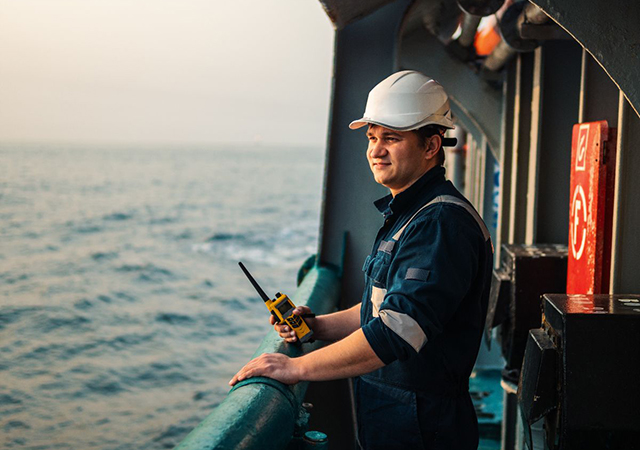
Turning operational data into consistent day-to-day decisions remains one of the offshore sector’s biggest challenges.
In practical terms, that looks like the loop we describe in the whitepaper. Validated data compared against a vessel’s own history and its sister ships is turned into a specific recommendation, reviewed by people with marine experience, and delivered to the crew in a form they can act on.
AI will also boost optimisation capabilities, but its full value will always depend on field expertise, particularly in maritime.
Where This Goes Next
Over the next five years, we expect vessel operations, across oil and gas, offshore wind and subsea alike, to become far more efficient, with more fuel savings, lower CO2 emissions and better use of vessel cargo capacity. They should also become safer and more reliable, with fewer breakdowns. Learning from past incidents and decisions, together with AI and predictive and prescriptive models, will drive this.
Real-time data collection from existing onboard systems and sensors will also increase sharply. The starting point is modest, as only 10% of the OSV fleet currently shares fully automated data ashore. Data will also be used in more varied ways, shared through APIs or accessed through chatbots, depending on the user’s preferences and role. And digital players will collaborate far more, to create more value for end customers.
Closing the conversion gap requires no new hardware or waiting for new vessels and fuels. The fastest lever available to operators today is running the existing fleet on data it can already defend. For a region where offshore activity remains central to energy production, and where compliance and commercial pressure are both increasing, that is a capability worth building now rather than waiting for.
The Conversion Gap: What Offshore Fleets Lose Between Data and Decision is available to download here.
About the Author: Arnaud Dianoux, Founder and CEO, Opsealog
With 10 years at sea, including as a Merchant Marine Captain in various regions, and a further 10 years at Opsealog, Arnaud Dianoux is deeply committed to operational efficiency and sustainability. After pursuing an MBA and focusing on maritime innovation, Arnaud founded Opsealog to deliver “Efficiency as a Service.” His expertise in data-driven solutions has enabled Opsealog to help shipowners and charterers optimise performance, reduce costs, and enhance sustainability across global fleets.