
 Molecular additive enhances efficiency and stability of lead-free perovskite solar cells
Researchers from Sophia University and National Institute for Materials Science (NIMS) have developed a new additive engineering strategy that significantly improves both the efficiency and stability of tin-based perovskite solar cells, addressing a key challenge in the development of environmentally friendly alternatives to lead-based photovoltaics.
Metal halide perovskite solar cells (PSCs) have emerged as promising candidates for next-generation solar energy technologies due to their high efficiencies and potentially lower manufacturing costs. However, while lead-based perovskites have achieved impressive photovoltaic performance, concerns over toxicity continue to hinder their commercial adoption.
As a result, researchers are increasingly turning their attention to tin-based perovskites as a safer, lead-free alternative. Yet these materials face a major obstacle of their own: rapid degradation caused by the oxidation of tin, which significantly reduces both device efficiency and operational lifetime.
A research team from Sophia University and the National Institute for Materials Science (NIMS) in Japan has now demonstrated how a carefully designed molecular additive can tackle several of these challenges simultaneously. Their study introduces 2-aminobenzothiazole (2-ABZ) into quasi-two-dimensional (q-2D) Ruddlesden-Popper tin perovskites, creating a multifunctional passivation strategy that enhances photovoltaic performance while improving long-term stability.

Professor Yuko Takeoka
The research was led by Professor Yuko Takeoka of Sophia University’s Faculty of Science and Technology, Department of Materials and Life Sciences, in collaboration with Dr. J. Obila, now at North-West University in South Africa, and Dr. Yasuhiro Shirai and Dr. Masatoshi Yanagida of NIMS. The findings were published in Solar RRL following online release in May 2026.
Multifunctional Molecular Stabilisation
Unlike many additives that address only a single degradation pathway, 2-ABZ performs multiple functions during both the formation and operation of the perovskite film.
The heteroatom-containing molecule, composed of nitrogen, sulfur, carbon and hydrogen, acts as a molecular stabiliser throughout the device architecture. Researchers found that it helps regulate crystallisation, reduce defect formation, suppress ion migration, inhibit tin oxidation and improve interfacial energy alignment.
The work stems from Prof. Takeoka’s long-standing interest in perovskite materials and their potential to support safer photovoltaic technologies.
“I’ve been researching perovskite compounds for over 25 years, and I wanted to use that knowledge to make safer solar cells, so I applied to JST ALCA-Next with the NIMS group. The acceptance of our proposal was the kick-off for this research,” mentioned Prof. Takeoka.
According to the researchers, the additive plays a particularly important role during film formation by improving crystal growth and reducing buried defects within the perovskite layer.
“The buildup of 2-ABZ at the interface is crucial for decreasing buried defects in the perovskite layer by creating densely populated nucleation sites at the base of the layer, resulting in the production of a high-quality and stable film,” explained Prof. Takeoka.
Stronger Efficiency Performance
The improvements in crystal quality translated directly into enhanced solar-cell performance.
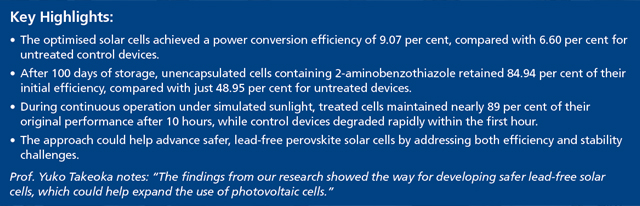
The optimised devices achieved a power conversion efficiency of 9.07 per cent, compared with 6.60 per cent for untreated control devices. Researchers also reported improvements in open-circuit voltage, photocurrent generation and device reproducibility, while reducing operational hysteresis.
The results suggest that additive engineering can provide a practical pathway for overcoming some of the intrinsic limitations that have constrained the performance of tin-based PSCs.
Stability Gains Address Challenges
While efficiency remains important, long-term stability is considered one of the most critical requirements for commercial deployment.
Surface analysis showed that the addition of 2-ABZ effectively suppressed the oxidation of tin from Sn2+ to Sn4+, one of the principal degradation mechanisms affecting tin perovskites. Researchers also observed a substantial reduction in oxidised iodine species, while time-of-flight secondary ion mass spectrometry confirmed that iodide migration was significantly inhibited.
These material-level improvements translated into measurable gains in durability. In storage tests, unencapsulated devices containing 2-ABZ retained 84.94 per cent of their original efficiency after 100 days, compared with 48.95 per cent for untreated devices. Under continuous simulated sunlight, treated solar cells maintained nearly 89 per cent of their initial performance after 10 hours of operation.
Advancing Safer Solar Technologies
Although silicon-based solar panels dominate today’s photovoltaic market, perovskite solar cells offer several advantages, including lightweight construction, flexibility and the ability to be produced in a range of shapes and form factors.
However, improving both efficiency and durability remains essential if lead-free perovskite technologies are to move beyond the laboratory and achieve widespread commercial adoption.
“The findings from our research showed the way for developing safer lead-free solar cells, which could help expand the use of photovoltaic cells,” mentioned Prof. Takeoka.
Pathway to Future Applications
The study demonstrates how targeted molecular engineering can improve multiple aspects of device performance simultaneously, from crystal formation and defect reduction to efficiency enhancement and long-term stability.
As the solar industry seeks sustainable alternatives to lead-based materials, the findings provide further evidence that additive engineering could play a critical role in advancing commercially viable tin-based perovskite solar cells and accelerating the development of next-generation photovoltaic technologies.