 Solar, wind and biofuels: What Europe’s latest trade data reveal
The rapid expansion of renewable energy capacity across Europe is driving demand for clean-energy technologies, while also reshaping the bloc’s trade relationships with key global suppliers.
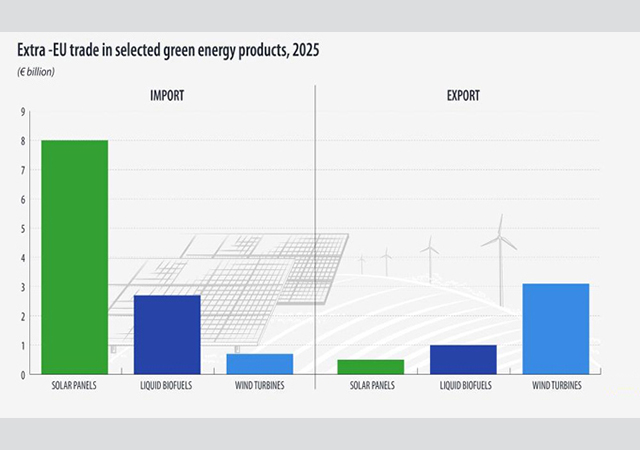
Latest figures from Eurostat show that the EU imported €11.4 billion ($12.8 billion) worth of green energy products in 2025, including solar panels, biofuels and wind turbines. Exports totalled €4.6 billion, underlining the bloc’s position as a major consumer of clean-energy technologies while remaining a significant exporter of high-value renewable energy equipment.
Solar Panels Continue to Dominate Imports
Solar photovoltaic technology remained the EU’s largest green energy import category by a considerable margin, reflecting the rapid deployment of solar projects across the region.
However, the market also showed signs of adjustment. The value of solar panel imports fell by 27.7 per cent to €8 billion in 2025, while import volumes declined by only 4 per cent. The difference between value and volume trends suggests a significant decline in average prices, continuing the downward pressure that has characterised global solar markets in recent years.
For developers and project owners, lower module prices have improved the economics of solar deployment. For manufacturers, however, the trend has intensified competition and renewed debate over Europe’s dependence on imported solar equipment.
No country illustrates that dependency more clearly than China. In 2025, China accounted for 98.6 per cent of all solar panel imports into the EU, reinforcing its dominant role in the global photovoltaic supply chain despite ongoing efforts within Europe to scale up domestic manufacturing capacity.
Biofuel Trade Undergoes a Shift
Biofuel imports also declined during the year, although the sector experienced a more notable change in supplier dynamics.
The value of biofuel imports fell 7.9 per cent to €2.7 billion, while volumes dropped 11.6 per cent, reflecting softer demand and changing sourcing strategies.
Malaysia emerged as the EU’s largest biofuel supplier, accounting for 21.9 per cent of imports. The United States followed with 16.1 per cent, ahead of Argentina (12.4 per cent) and the United Kingdom (12.3 per cent).
Perhaps the most striking development was the dramatic decline in China’s role within the biofuels market. The country’s share of EU biofuel imports dropped from 24.2 per cent in 2024 to just 1.3 per cent in 2025, while both Malaysia and the US significantly expanded their presence.
The shift reflects the changing geography of renewable fuel supply chains as policymakers and industry players seek to diversify sourcing and strengthen supply security.
Wind Sector Strengthens
While solar imports weakened and biofuel trade softened, the wind energy sector delivered one of the strongest performances of the year.
EU imports of wind turbines increased by 40.6 per cent in value to €700 million, while import volumes surged by 69 per cent, indicating robust demand for new generating capacity as countries accelerate renewable energy deployment.
China strengthened its position as the bloc’s largest supplier of imported wind turbines, increasing its market share from 41.3 per cent in 2024 to 59.6 per cent in 2025. India ranked second with a 22.2 per cent share of imports.
The growth in wind turbine imports reflects continued investment in both onshore and offshore wind projects, a cornerstone of Europe’s long-term energy transition strategy.
Europe’s Export Strength Lies in Wind
While the EU remains heavily dependent on imports for solar technologies, the picture looks markedly different in the wind sector.
Wind turbines were Europe’s leading green-energy export product in 2025, generating €3.1 billion in export revenues. Export values rose 10.8 per cent, while volumes increased 9.5 per cent, highlighting sustained international demand for European wind technology and engineering expertise.
The performance reinforces the EU’s competitive position in the global wind industry, where European manufacturers continue to play a leading role despite growing competition from Asian suppliers. By contrast, exports of solar panels and biofuels declined sharply. Solar panel exports fell 23.6 per cent to €500 million, despite a modest rise in volumes, while biofuel exports dropped 45.9 per cent to €1 billion, accompanied by a similar decline in traded volumes.
A Sector in Transition
Taken together, the figures paint a picture of a renewable energy market undergoing rapid change.
The EU continues to depend heavily on imported solar technologies to support its clean-energy rollout, while wind energy remains an area of industrial strength and export competitiveness. At the same time, shifts in biofuel sourcing patterns highlight the growing importance of supply-chain diversification amid evolving trade and sustainability considerations.
As Europe pursues ambitious climate and energy targets, balancing domestic manufacturing ambitions with affordable renewable technologies will remain a challenge. The latest trade data suggest that while the green transition is accelerating, the structure of global clean-energy supply chains continues to shape how that transition unfolds.