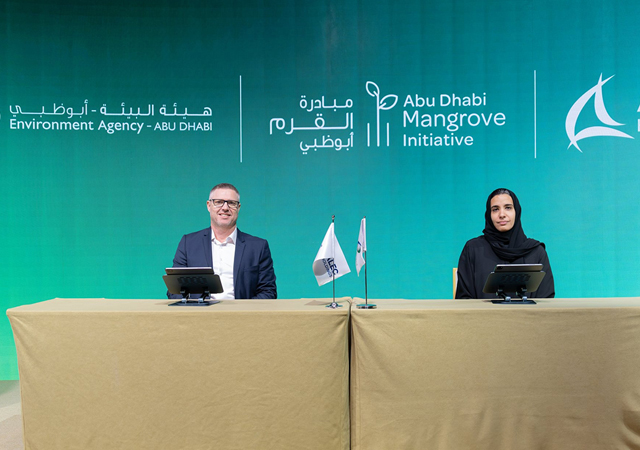
 Sean McQue (left) and Maitha Mohamed Al Hameli announcing the project details
Mangroves have become a cornerstone of the UAE’s environmental agenda, valued not only for their ability to capture and store carbon but also for their role in protecting coastlines, supporting biodiversity and enhancing climate resilience. Yet conservation experts increasingly recognise that successful restoration requires more than simply increasing tree numbers. It depends on ensuring that the ecological conditions supporting these habitats remain intact.
Against this backdrop, ALEC Engineering and Contracting has partnered with the Environment Agency – Abu Dhabi (EAD) on a pioneering hydrological mangrove restoration project designed to investigate how restoring natural water flows can improve the long-term health and resilience of mangrove ecosystems.
The three-year initiative, the first of its kind in Abu Dhabi, will explore whether rehabilitating the hydrological conditions of a degraded mangrove site can enable the ecosystem to recover naturally and sustainably over time.
Looking Beyond Traditional Restoration
Mangrove restoration projects around the world have often focused on replanting programmes. While these can produce positive outcomes, environmental scientists increasingly argue that long-term success depends on understanding and restoring the underlying ecological processes that sustain these ecosystems.
The Abu Dhabi pilot seeks to address that challenge by examining how hydrology, the movement and availability of water within an ecosystem, influences mangrove health.
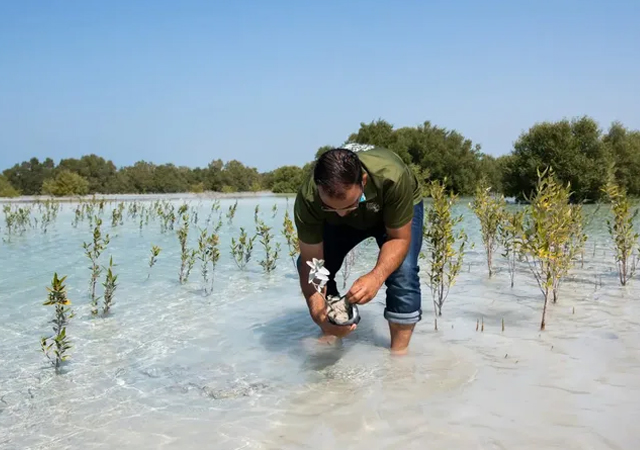
Beyond tree planting: Abu Dhabi tests new model for mangrove restoration
Under the agreement, EAD will lead the scientific design and delivery of the project, including site selection, ecological and hydrological assessments, identification of restoration interventions, and long-term monitoring of environmental outcomes.
The initiative will establish baseline ecological conditions for the selected site and track progress against specific restoration and biodiversity indicators. The findings are expected to deepen scientific understanding of mangrove hydrology in Abu Dhabi and provide valuable guidance for future ecosystem restoration projects.
Supporting Climate and Biodiversity Goals
The project aligns closely with the objectives of the Abu Dhabi Mangrove Initiative, which promotes science-based approaches to mangrove conservation and restoration, while also supporting the UAE’s wider climate and biodiversity commitments.
Rather than focusing solely on short-term restoration outcomes, the pilot aims to generate evidence that can help environmental planners better understand how protection measures, hydrological restoration and long-term monitoring can work together to create durable ecological benefits.
For Abu Dhabi, where mangroves form an important part of the emirate’s coastal environment, such knowledge could prove increasingly valuable as environmental pressures and climate-related challenges continue to evolve.
A New Chapter in Corporate Environmental Stewardship
For ALEC, the project represents a significant step in the company’s sustainability journey and a shift towards direct investment in nature-based solutions.
Earlier this year, the company signed the Abu Dhabi Mangrove Initiative Partners Pledge, committing to support mangrove conservation, science-based restoration and the protection of blue carbon ecosystems. The new project is the first flagship biodiversity restoration initiative undertaken by the company and forms part of its broader effort to integrate biodiversity considerations into its sustainability strategy.
Commenting on the partnership, Maitha Mohamed Al Hameli, Acting Executive Director of Terrestrial and Marine Biodiversity at EAD, highlighted the importance of science-led collaboration.
“We welcome ALEC’s support for this pilot, which reflects the kind of long-term, science-based commitment the Abu Dhabi Mangrove Initiative was established to encourage. The findings will strengthen our understanding of how mangrove sites respond to restored hydrological conditions and will inform how we plan future restoration in the emirate.
“Through this pilot, we aim to build the scientific evidence needed for long-term solutions that safeguard Abu Dhabi’s mangroves, a defining feature of the emirate’s natural heritage.”
Generating Measurable Environmental Outcomes
Unlike many corporate sustainability initiatives that focus primarily on awareness or offsetting activities, the project is designed to generate measurable ecological outcomes through rigorous monitoring and scientific assessment.
ALEC will support the collection of baseline environmental data, biodiversity monitoring and conservation activities linked to the restoration site. The collaboration is intended to help build a clearer understanding of ecosystem recovery processes while contributing directly to the protection of a priority coastal habitat.
According to Sean McQue, Managing Director of ALEC, the initiative reflects a desire to translate environmental commitments into practical action.
“Abu Dhabi is a capital defined by extraordinary ambition, creating next-generation cultural and visitor experiences while protecting the natural heritage that gives the emirate its identity. For ALEC, this partnership is an important step in turning our commitment to nature into tangible action.”
He added: “As our first biodiversity restoration investment, the project enables us to contribute directly to the protection and restoration of Abu Dhabi’s mangrove ecosystems, while supporting a science-led approach that will generate measurable biodiversity outcomes. Through this pilot, we are supporting the development of the knowledge, evidence and practical understanding needed to help these vital ecosystems recover and thrive. In doing so, we are proud to support Abu Dhabi’s ambition to protect its natural heritage and contribute to a more resilient future for the emirate.”
Engaging Employees and Communities
The initiative will also create opportunities for employee participation through environmental awareness programmes, educational activities and structured volunteering initiatives.
These are expected to include citizen-science monitoring programmes and community engagement activities designed to strengthen understanding of coastal ecosystems and the role they play in environmental resilience.
Such initiatives reflect a broader trend within corporate sustainability programmes, where organisations are increasingly seeking to involve employees directly in conservation efforts rather than limiting engagement to financial support alone.
Building Resilience Through Nature
As governments and businesses look for effective ways to address climate and biodiversity challenges, nature-based solutions are gaining increasing attention for their ability to deliver multiple environmental benefits simultaneously.
Mangroves are among the most valuable of these ecosystems, providing carbon storage, coastal protection, habitat creation and water-quality benefits. However, their long-term health depends on maintaining the natural environmental conditions that support them.
By focusing on hydrological restoration rather than simply replanting, the ALEC-EAD partnership aims to tackle ecosystem recovery at its source. In doing so, the project could help establish a model for future restoration efforts that prioritises ecological resilience, scientific evidence and long-term environmental value.