 Steel growth shifts to the Middle East
The Middle East is cementing its status as one of the world’s most promising steel markets, supported by nearly $2 trillion worth of infrastructure, industrial and energy projects and a steel market projected to expand from $44 billion in 2026 to $60 billion by 2031.
As steel producers worldwide contend with shifting trade dynamics, mounting decarbonisation pressures and uncertain demand patterns, the region is increasingly attracting attention as a source of growth, investment and industrial expansion. These themes will be central to discussions at Fastmarkets’ Middle East Iron & Steel (MEIS) 2026 conference, taking place in Dubai this November.
Regional host sponsor EMSTEEL’s Group CEO, Eng Saeed Ghumran Al Remeithi, will join industry leaders including Ahmed Ezz, CEO of Ezz Steel; Sharjeel Azhar, CEO of Al Ittefaq Steel Products; Dr Salam Al Sharif, Chairman of Al Sharif Metals Group & BMR; Sanjay Roychoudhury, CEO of UNICOIL; and Jose Noldin, CEO of GravitHY, to discuss the region’s evolving role in global steel markets.
Regional production gains
The Middle East’s growing influence is also reflected in production trends. According to Fastmarkets analysis, GCC crude steel output reached 21.6 million tonnes in 2025, representing year-on-year growth of 9.5 per cent. The region’s steel industry is also distinguished by its high adoption of electric arc furnace (EAF) technology, which accounts for approximately 95 per cent of crude steel production, positioning regional producers favourably as demand grows for lower-carbon steel.
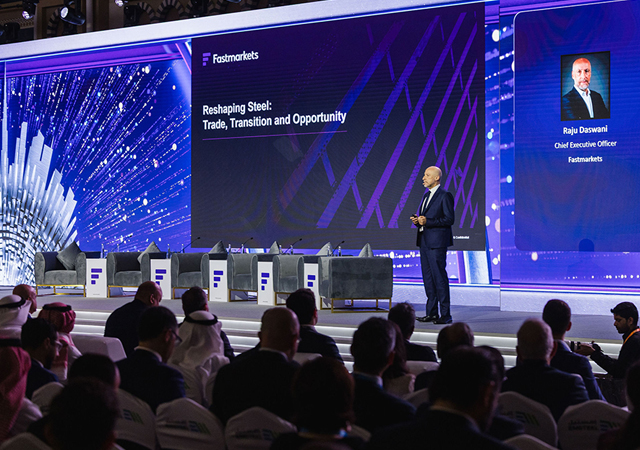
“The past year has been challenging for many parts of the steel industry, making it more important than ever to focus on where real opportunities are emerging,” said Raju Daswani, CEO of Fastmarkets. “The Middle East combines significant investment, growing demand, ambitious industrial development and a strong position in lower-carbon steelmaking.”
Echoing this view, Eng Saeed Ghumran Al Remeithi, Group CEO of EMSTEEL, noted that the region is transitioning from large-scale industrial ambitions to project execution, supported by continued investment in infrastructure, manufacturing and industrial development.
Navigating market shifts
Industry participants are also closely watching the factors reshaping regional steel markets, including major construction and industrial projects, evolving trade flows, tariffs, carbon regulation and the availability of critical raw materials such as scrap, DR-grade iron ore, pellets, DRI and HBI.
Against this backdrop, MEIS 2026 will provide a platform for producers, traders, raw material suppliers and end users to assess how the Middle East’s steel sector is adapting to global market changes while strengthening its position within the industry’s evolving value chain.
Middle East Iron & Steel 2026 will take place from November 16-18 at Madinat Jumeirah, Dubai.