



































 Sumitomo Electric’s award-winning monitoring technology enables real-time detection of anomalies along HVDC submarine cables spanning more than 600 km, helping improve energy security and reduce fault response times.
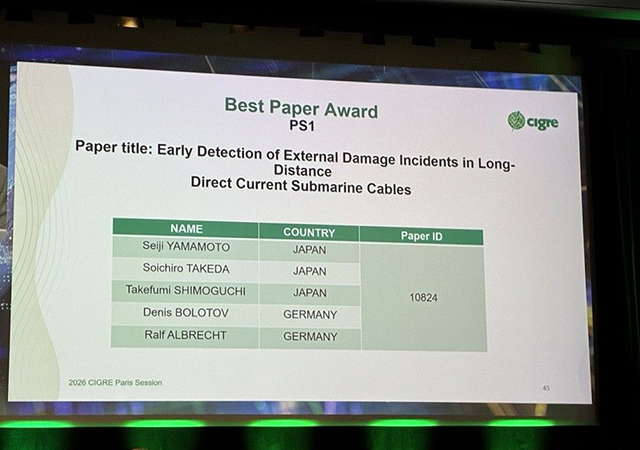
Sumitomo Electric Industries has received the Best Paper Award in the B1 PS1 category at the CIGRE Paris Session 2026 for developing what it describes as the world’s first technology capable of detecting anomalies and external damage along high-voltage direct current (HVDC) submarine cables extending beyond 600 km.
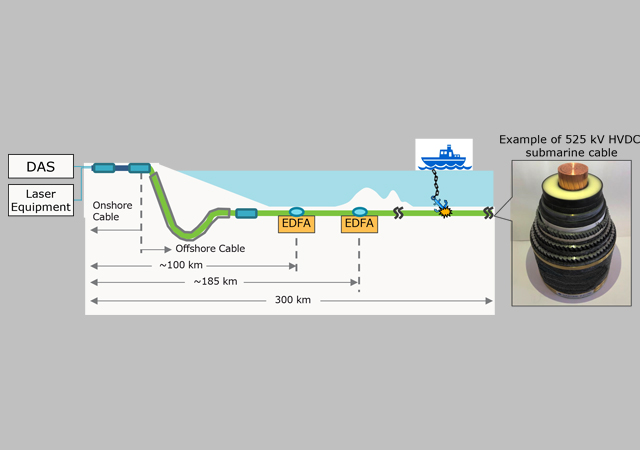
The solution combines Sumitomo Electric’s ultra-low-loss optical fibre and remotely pumped erbium-doped fibre amplifier (EDFA) technologies with a commercial Distributed Acoustic Sensing (DAS) platform supplied by AP Sensing GmbH. Together, the technologies enable continuous, real-time monitoring of long-distance submarine power cables, addressing a longstanding challenge in the protection of critical subsea energy infrastructure.
Addressing a Growing Infrastructure Risk
As renewable energy projects expand and cross-border electricity interconnections increase, HVDC submarine cable systems are being deployed over greater distances and with capacities reaching the gigawatt scale. At the same time, incidents involving subsea communications cables have highlighted the vulnerability of critical offshore infrastructure to damage from ship anchors, fishing activity and other third-party interference.
Traditionally, most sections of long submarine power cables have remained effectively unmonitored, making it difficult to detect incidents quickly and accurately. When faults occur, particularly in remote offshore locations, operators face lengthy investigations, high repair costs and potentially prolonged transmission outages.
Conventional fault-location techniques typically provide accuracy within approximately 1 per cent of a cable’s total length, meaning a fault on a 600 km link may only be narrowed down to a search area of around 6 km.
Extending DAS Monitoring Beyond 300 km
Distributed Acoustic Sensing systems can detect minute vibrations within optical fibres and identify abnormal events in real time. However, the monitoring range of conventional DAS systems has generally been limited to around 100 km.
By integrating AP Sensing’s DAS technology with Sumitomo Electric’s Z-PLUS Fiber 130ULL ultra-low-loss optical fibre and remotely pumped EDFA technology, the companies have extended the monitoring range to more than 300 km. A 270 km monitoring distance had already been successfully demonstrated when the award-winning paper was submitted.
The remotely pumped EDFA configuration places laser equipment and power supplies onshore rather than on the seabed, eliminating potential offshore failure points while simplifying maintenance and improving reliability.
Because all core components have established operational track records, the solution can be implemented without the need for entirely new enabling technologies, potentially accelerating commercial deployment.
Submarine cables being loaded on the ship. Video sourced from Sumitomo Electric.
Monitoring Entire 600 km Cable Links
Monitoring from both ends of a submarine cable circuit enables continuous surveillance of HVDC cable systems exceeding 600 km in length.
According to Sumitomo Electric, the approach improves theoretical fault-location accuracy by a factor of 33 compared with conventional techniques, reducing uncertainty to less than 200 metres, or approximately 0.03% of cable length.
The company validated the technology during a field trial conducted off Japan’s Awaji Island. Using an optical fibre integrated within an HVDC submarine cable, researchers simulated an anchor strike by dropping a weighted object near the 262 km point. The system identified the impact location with an error of just 68.4 metres.
Supporting Infrastructure Resilience
Beyond fault detection, the technology could help operators identify and monitor vessels approaching cable infrastructure based on the vibration signatures transmitted through the cable system.
As long-distance HVDC networks become increasingly important for renewable energy integration and energy security, improved visibility of subsea assets is expected to play a growing role in enhancing grid resilience and reducing operational risk.
Sumitomo Electric said the technology could significantly shorten fault investigation and repair timelines, helping reduce both outage durations and project operating costs.
The company is now seeking to advance the practical deployment of the monitoring system.
The award-winning work was carried out as part of a project commissioned by Japan’s New Energy and Industrial Technology Development Organization (NEDO).
Award Details
Award: CIGRE Paris Session 2026 Best Paper Award (B1 PS1)
Paper: Early Detection of External Damage Incidents in Long-Distance Direct Current Submarine Cables (Paper ID: 10824)
Recipients: Seiji Yamamoto, Soichiro Takeda and Takefumi Shimoguchi (Sumitomo Electric Industries), along with Denis Bolotov and Ralf Albrecht (AP Sensing GmbH)
Date: 28 August 2026
Venue: Palais des Congrès, Paris, France