









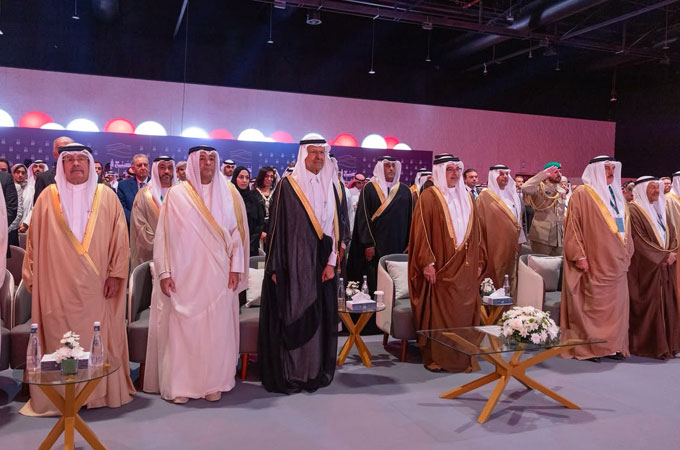
The Gulf countries have approved five joint industrial investment opportunities as part of an initiative to identify 20 projects across the GCC region, marking a step forward in efforts to deepen industrial integration and strengthen the region’s manufacturing base, remarked Jasem Albudaiwi, the Secretary-General of GCC, while speaking on the opening day of the inaugural 'Made in GCC 2026' event being held in Bahrain.
The five opportunities, completed during the first phase of the initiative, were approved by the GCC Industrial Cooperation Committee and will serve as a foundation for subsequent joint ventures, stated Albudaiwi at the three-day event which runs until October 8 at Exhibition World Bahrain in Sakhir.
The three-day event is being jointly organised by the GCC General Secretariat and the Ministry of Industry and Commerce in the Kingdom of Bahrain under the theme “Toward a More Integrated, Competitive, and Future-Ready Gulf Industrial Economy.”
“Made in GCC 2026 embodies a shared vision agreed upon by the leaders of the GCC states that industry is a foundational pillar for diversifying the Gulf economy, and that the strength of our economies is measured not only by the resources we possess, but by what we produce and export,” remarked Albudaiwi.
The forum carries a clear message that Gulf products should be the first choice for consumers and investors, both within member states and across global markets.
"This vision did not emerge in a vacuum; joint Gulf industrial action has been built over the years upon a solid foundation of policies and resolutions, unifying standards and specifications, facilitating the movement of industrial goods and materials, protecting Gulf products, promoting fair competition, and supporting supply chain integration. As a result, GCC states today host more than 22,000 factories employing over 1.7 million workers, with manufacturing contributing 13% to the GCC’s gross domestic product (GDP)," stated the top official.
In the same context, Albudaiwi pointed out that the GCC Industrial Cooperation Committee plays a pivotal role at the heart of this journey in advancing Gulf industrial integration.
The committee’s efforts have yielded significant milestones, most notably unifying key industrial legislation, adopting the GCC Industrial Strategy 2022–2030, empowering national products, and extending collective protection to Gulf industries, he added.
On the industrial investment front, Albudaiwi noted that GCC states launched an ambitious project aimed at identifying 20 joint Gulf industrial investment opportunities, having completed five opportunities in its first phase, approved by the Industrial Cooperation Committee, to serve as a foundation for subsequent ventures.
Elaborating further, Albudaiwi said: “International indicators reaffirm the distinguished global standing achieved by GCC states in the industrial sector. According to the 2025 Competitive Industrial Performance index issued by UNIDO, which assesses manufacturing production and export capacity, technological deepening and upgrading, and global impact, the UAE ranked 32nd globally followed by the Kingdom of Saudi Arabia at 34th, Qatar 48th, Kuwait 53rd, Oman 58th, and the Kingdom of Bahrain 63rd.”
According to him, the GCC states occupy six of the top seven positions in the Arab world, with two member states surpassing the global index average.
“These figures inspire pride in what has been accomplished and motivate joint efforts toward even greater milestones. When our industrial capabilities integrate and policies unify, member states achieve what no country could accomplish alone, advancing progress toward Sustainable Development Goal 9: Industry, Innovation, and Infrastructure,” he added.-TradeArabia News Service