















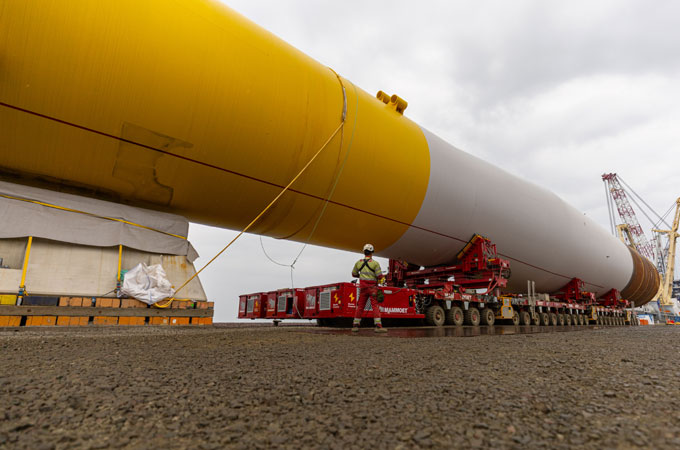
Mammoet, a global leader in engineered heavy lift and transport sector, continues to lead the way in the electrification of heavy lifting and transport, performing the first ever electric-powered marshaling of a monopile in real-world conditions.
With the support and collaboration of Van Oord, and project developers Ørsted and PGE, this landmark movement was performed during the onshore marshalling of key components for the Baltica 2 Offshore Wind Farm, which is being developed jointly by Ørsted and PGE.
Earlier this year, Mammoet was invited by Van Oord to discuss how it could support with its sustainability initiatives. Together, the two companies agreed on a real-world pilot of an electric monopile transport and nominated Baltica 2 as the project during which it should take place.
Mammoet worked with Van Oord to receive, marshal, and load-out 111 1,700t monopiles at the Port of Ronne in Denmark. For the pilot, a single 1,700t monopile was transported 815 meters.
Based on the gathered data during this pilot, Mammoet is confident that the system can serve all site moves and SPMT lifts necessary to move the monopile from storage to quayside – on a single charge.
The electric transport was achieved using 3 x 26 axle lines of Mammoet Self-Propelled Modular Transporter (SPMTs), fitted with its XXL Monopile Handling System to lift and cradle the module, all powered by three electric Power Pack Units (ePPUs).
Niek Bezuijen, Global Sustainability Advisor at Mammoet said: "We were very pleased with the results of the pilot. The transport was completed successfully, without charging and without impacting the project schedule."
"It really demonstrates that we can help offshore wind farm developers to bring down their carbon impacts today, and what will be possible in the future," he stated.
For a project layout similar to Baltica 2, electric monopile transportation could avoid an estimated 25,000 – 30,000 liters of diesel use - equivalent to roughly 70 tonnes of CO₂ emissions. Thus, the system contributes to the decarbonization of the logistics chain for offshore wind projects.
During the project, Mammoet also utilized its innovative MTC1600 cranes, which have been designed to efficiently lift next-gen monopiles into the water directly - saving time and cost on ballasting during RoRo operations.
The MTCs have their own power packs, which have been designed to have compatibility with either batteries or direct grid connection - but can operate at limited capacity using an SPMT ePPU, if backup power is needed.
Using the data from the transport pilot, Mammoet calculated that it would already be possible to perform a single monopile lift using an MTC1600 crane on one ePPU charge, without disrupting on-site activities, compared to diesel or HVO operations.
This decarbonization project demonstrates the high potential for decarbonization of offshore wind marshaling work possible with increased investment in shore power facilities for vessels.