

































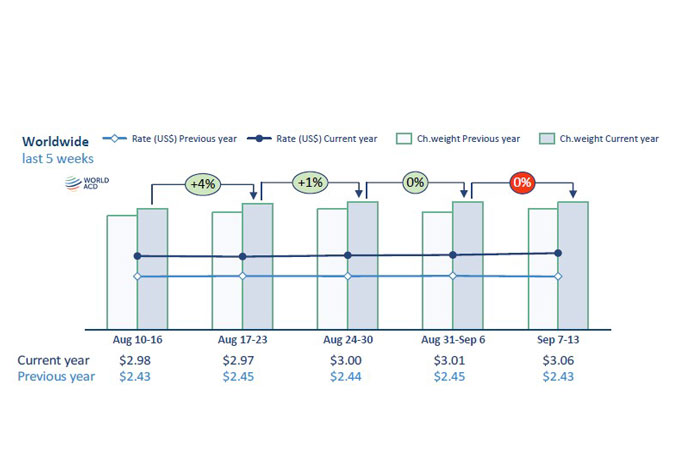
 WorldACD tonnage graph
Air cargo tonnages, spot rates and capacity from Asia Pacific all rose in the second week of September, although the strong performance was partly a rebound from national holidays the previous week in Vietnam and Malaysia.
According to the latest weekly figures from WorldACD Market Data, chargeable weight from Asia Pacific origins rose by 4%, week on week (WoW), in week 37 (September 7 to 13), with spot rates increasing by a further 3%, their third consecutive WoW rise, to an average of $4.69 per kilo.
Globally, air cargo tonnages and capacity were broadly stable in the second week of September, while average rates crept back upwards with a 2% WoW rise, based on a mix of spot and contract rates. Worldwide average spot rates were up by 3%, WoW, driven largely by those increases in Asia Pacific prices, but also a 3% rise ex-Europe and a 2% WoW increase from North America origins. In demand terms, the 4% WoW rise in volumes from Asia Pacific origins, along with a 4% increase from Africa, were offset by a -14% drop in volumes from North America linked to annual Labour Day holidays in the US and Canada on September 7.
Capacity from Asia Pacific rose by 1%, WoW, in week 37, while there was a -3% WoW drop from Africa and small declines of around -1% from other regions. Year on year (YoY), total worldwide capacity is up by around 2%, with freighter capacity up 3% and belly capacity by just under 2%.
Within those Asia Pacific figures, the biggest changes in capacity and volumes in week 37 were linked to Southeast Asia, particularly Vietnam lanes. Volumes from Vietnam to Europe recorded a 44% WoW rebound after dropping by -24% the previous week, and Malaysia-to-Europe tonnages rebounded by 19% after declining by -30% the previous week. Similarly, chargeable weight from Vietnam to the US rebounded by 24% WoW after dropping by -27% the previous week, and Malaysia-to-US tonnages regained by 7% after declining by -9% in week 36. Those rebounds for Vietnam and Malaysia in week 37 broadly mirror the patterns in week 37 last year.
Strong transpacific markets
Other comparisons with last year are also noteworthy, especially on transpacific markets, which last year were deeply affected by the fast-changing US import tariff landscape. For example, high tariffs and the end of the US ‘de minimis’ exemptions meant that Hong Kong-to-US tonnages in week 37 last year were down by around -18%, YoY, and volumes from South Korea by -25%. Despite the tariff challenges, strong demand for semiconductors and other high-tech goods last year, as this year, meant volumes to the US from Taiwan, Vietnam and Thailand were up by 53%, 62% and 28%, YoY, respectively, this time last year.
This year, in week 37, tonnages from Hong Kong to the US have rebounded with a 20% YoY gain, and volumes from South Korea – boosted by semiconductors and other high-tech demand – are up by 53%, YoY, although South Korea volumes may be slightly inflated by frontloading ahead of next week’s Chuseok holiday. And strong demand has continued from Taiwan, Vietnam and Thailand, with further gains of 11%, 2% and 23%, respectively, YoY. Volumes from Singapore and Indonesia to the US are also up strongly, YoY, by 26% and 33%, respectively.
Providing further evidence of the current strong US appetite for advanced semiconductors, another market that has been growing very significantly in the last five weeks is Japan to the US, where tonnages across those five weeks are up by an average of 25%, YoY. Tonnages from China to the US this year have also strengthened significantly and were up by 17%, YoY, in week 37, whereas they were broadly flat this time last year. Overall, Asia Pacific to the US demand in week 37 was up by 17%, YoY.
China-to-Europe volumes slowly rebuilding
The same cannot be said for Asia Pacific to Europe, where despite a 2% WoW rise in tonnages in week 37, volumes remain down, YoY, by -6%. That reduction is mainly due to the continued weakening of the Hong Kong-to-Europe market since the removal on July 1 of EU de minimis exemptions on goods valued at less than €150. Hong Kong-to-Europe tonnages in week 37 were down, YoY, by -24%, despite a slight further (1%, WoW) rise in volumes. That’s the fourth consecutive small WoW rise for the Hong Kong-to-Europe market, indicating a market that has stabilised and is slowly rebuilding after two months of declines. Meanwhile, tonnages from mainland China to Europe also regained a further 1%, WoW, in week 37 – their sixth consecutive WoW rise – taking China-to-Europe volumes back slightly (1%) higher, YoY, for the first time since the beginning of July.
Gulf Area capacity down still -16% versus pre-conflict level
Overall capacity to and from the Middle East & South Asia (MESA) region was relatively stable in week 37 on a WoW basis, but capacity to and from Gulf markets specifically have seen some bigger changes, with reductions to Europe of around -3%, WoW, offset by increases to North America and Africa (4%), and within the Gulf Area (3%, WoW). Capacity to and from MESA in week 37 still remains down significantly (-8%) compared with its level in week 7, prior to the start of the US-Iran conflict.
Although capacity to and from South Asia has recovered to levels (3%) higher than in mid-February, capacity to and from the Gulf Area remains down by about -16%, including declines of around -24% to Europe, -21% to Asia Pacific, and -9% to North America. In the same period, volumes from MESA to Europe in week 37 were down by around -12% vs week 7, with tonnages from Dubai to Europe down by almost -60%. However, tonnages from MESA to the US in week 37 were up by around 12% vs week 7, largely driven by strong growth from India (14%), but also with a good contribution from Bangladesh (58%) while volumes from Dubai were down (-14%).—TradeArabia News Service