
















Emirates Biotech and United Arab Emirates University (UAEU) have launched a joint research project to design, build and operate the UAE’s first integrated organic-waste valorisation pilot plant, aiming to convert mixed food waste and compostable packaging into renewable biogas and nutrient-rich compost.
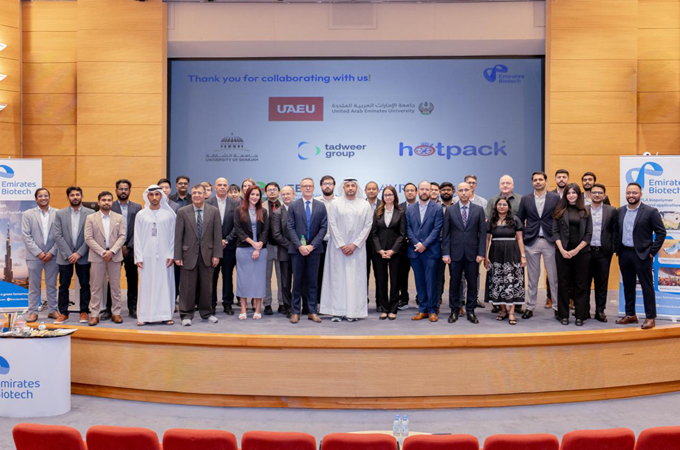
The partnership was officially launched at UAEU in Al Ain in
the presence of value chain stakeholders, including the Emirates Environmental
Group, Hotpack, AW Rostamani Group (VerraPak), Tadweer Group, University of
Sharjah and Pacogreen.
Located near the UAEU campus, the pilot plant will process up to 40kg of organic waste per day.
The two-year project, running from August
2026 to August 2028, will assess the technical, environmental and economic
performance of the integrated process and develop guidance to support potential
scale-up in the UAE and beyond. Installation and commissioning are expected to
be completed by August 2027.
Food waste accounts for nearly 40 per cent of daily municipal solid waste in the UAE, with a significant proportion disposed of in landfills.
Meanwhile, conventional plastic packaging contaminated with food residues can be difficult to recycle.
The project will investigate whether food
waste and compostable packaging can be processed together to recover resources
while reducing the volume of waste sent to landfill.
Dr Rami, Associate Provost for Research, UAEU stated: “At
UAEU, we believe that solving societal and environmental challenges requires
strong collaboration between academia and industry. Our partnership with
Emirates Biotech demonstrates how research and innovation can be translated
into practical, scalable solutions that support the UAE’s sustainability
goals.”
“This integrated pilot project will evaluate a practical
end-of-life pathway for food waste and compostable packaging while supporting
the UAE’s circular economy, food security and Net Zero ambitions. It will also
provide a platform for training students and researchers and strengthening
local capability in waste-to-resource technologies” said Professor Zafar Said
Sher, UAEU project lead.
The pilot plant will combine anaerobic digestion and composting. Anaerobic digestion will produce renewable biogas, while the resulting digestate will be composted to generate nutrient-rich compost.
A
laboratory-scale assessment will also examine the potential to convert the
biogas into renewable hydrogen.
Students and researchers will participate in the project,
gaining practical research and technical experience in waste-to-resource
technologies.
“The project will demonstrate a novel integrated biorefinery
concept for organic waste management in the UAE. Anaerobic digestion will
convert organic waste into renewable biogas, with the potential for upgrading
to green hydrogen. The resulting digestate will undergo composting to produce
nutrient-rich compost. Successful regional validation could be a game changer
for organic waste diversion and circularity, while demonstrating the role of
compostable packaging as an enabler.” Dr. Aman Kulshrestha, Chief Technology
Officer of Emirates Biotech added.
If successfully scaled, an integrated organic-waste valorisation
plant could reduce CO₂ emissions by up to 89 per cent compared with
landfilling.
The project is expected to generate technical evidence and establish a scalable, modular roadmap for transforming food waste and compostable packaging into renewable biogas and compost, supporting the UAE’s long-term waste-management, circular-economy and sustainability objectives. -TradeArabia News Service