
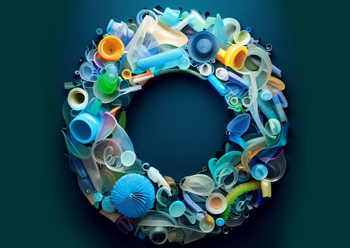
The plastics industry is facing increasing pressure to reduce its environmental impact. In recent years, there has been a growing awareness of the problem of plastic pollution, and governments around the world are introducing new regulations to reduce plastic waste.
In response to this challenge, the plastics industry is developing new technologies and innovations to create a more circular economy for plastics. A circular economy is a system where materials are kept in use for as long as possible, and waste is minimised.
According to the New Plastics Economy: Rethinking the Future of Plastics report applying circular economy principles to global plastic packaging flows could transform the plastics economy and drastically reduce negative externalities such as leakage into oceans.
The report provides, for the first time, a vision of a global economy in which plastics never become waste, and outlines concrete steps towards achieving the systemic shift needed.
The report was produced by the World Economic Forum and the Ellen MacArthur Foundation, with analytical support from McKinsey & Company, as part of Project MainStream, a global, multi-industry initiative that aims to accelerate business-driven innovations to help scale the circular economy. It was financially supported by the MAVA Foundation.
Plastics have become the ubiquitous workhorse material of the modern economy — combining unrivalled functional properties with low cost. Their use has increased 20-fold in the past half-century and is expected to double again in the next 20 years. Today nearly everyone, everywhere, every day comes into contact with plastics — especially plastic packaging, the focus of the report.
While delivering many benefits, the current plastics economy has drawbacks that are becoming more apparent by the day. After a short first-use cycle, 95% of plastic packaging material value, or $80 billion to $120 billion annually, is lost to the economy. A staggering 32% of plastic packaging escapes collection systems, generating significant economic costs by reducing the productivity of vital natural systems such as the ocean and clogging urban infrastructure. The cost of such after-use externalities for plastic packaging, plus the cost associated with greenhouse gas emissions from its production, is conservatively estimated at $40 billion annually — exceeding the plastic packaging industry’s profit pool.
In future, these costs will have to be covered. In overcoming these drawbacks, an opportunity beckons: enhancing system effectiveness to achieve better economic and environmental outcomes while continuing to harness the many benefits of plastic packaging, the report says.
The ‘New Plastics Economy’ offers a new vision, aligned with the principles of the circular economy, to capture these opportunities.
With an explicitly systemic and collaborative approach, the New Plastics Economy aims to overcome the limitations of today’s incremental improvements and fragmented initiatives, to create a shared sense of direction, to spark a wave of innovation and
to move the plastics value chain into a positive spiral of value capture, stronger economics, and better environmental outcomes.
The report outlines a fundamental rethink for plastic packaging and plastics in general; it offers a new approach with the potential to transform global plastic packaging materials flows and thereby usher in the New Plastics Economy.
At the heart of the New Plastics Economy initiative is a vision of a circular economy for plastic in which it never becomes waste.
The circular economy considers every stage of a product’s journey – before and after it reaches the customer. This approach is not only vital to stop plastic pollution, it also offers strong economic, social, and climate benefits. By 2040 a circular economy has the potential to:
* Reduce the annual volume of plastics entering our oceans by 80%
* Reduce greenhouse gas emissions by 25%
* Generate savings of $200 billion per year
* Create 700,000 net additional jobs
The vision has six key points:
* Elimination of problematic or unnecessary plastic packaging through redesign, innovation, and new delivery models is a priority.
* Reuse models are applied where relevant, reducing the need for single-use packaging.
* All plastic packaging is 100% reusable, recyclable, or compostable.
* All plastic packaging is reused, recycled, or composted in practice.
* The use of plastic is fully decoupled from the consumption of finite resources.
* All plastic packaging is free of hazardous chemicals, and the health, safety, and rights of all people involved are respected.
Here are some of the new developments in the plastics industry that are helping to create a more circular economy:
* New recycling technologies: There are a number of new recycling technologies being developed that can break down plastics into their original components, making them easier to recycle. For example, IBM's VolCat technology can convert used plastic bottles into clean bottles, and the CreaSolv Process Technology can recycle plastic sachets into new products.
* Biodegradable plastics: There are a number of new biodegradable plastics being developed that can be composted or broken down by microorganisms. These plastics offer a potential solution to the problem of plastic pollution, as they can be disposed of in a way that does not harm the environment.
* Reusable plastics: There are also a number of new reusable plastics being developed that can be used multiple times. These plastics offer a more sustainable alternative to single-use plastics, and they can help to reduce the amount of plastic waste that is produced.
These are just a few of the new developments in the plastics industry that are helping to create a more circular economy. As these technologies continue to develop, it is likely that we will see even more progress in the years to come.
The importance of circular plastics
Circular plastics are essential for creating a more sustainable future. By keeping plastics in use for as long as possible, we can reduce the amount of plastic waste that is produced and the environmental impact of the plastics industry.
Circular plastics also offer a number of economic benefits. By recycling plastics, we can create new jobs and reduce the need for virgin materials. In addition, circular plastics can help to improve the quality of the environment, which can benefit businesses and communities.