
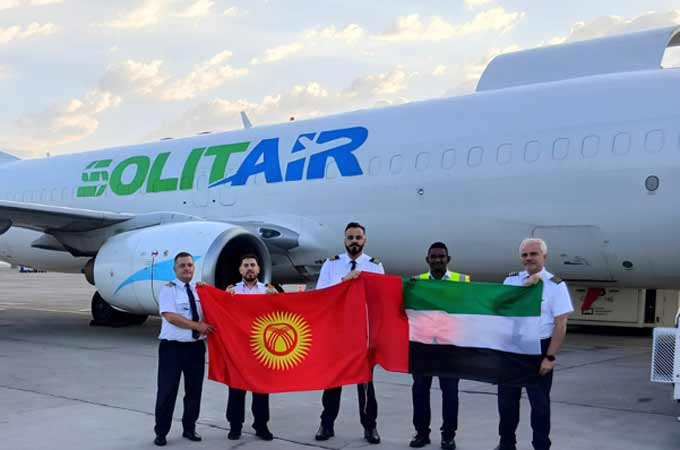
SolitAir, UAE’s dedicated next-generation B2B, airport-to-airport, express middle-mile cargo airline, has recently operated its first charter cargo service between Dubai World Central (DWC), Al Maktoum International Airport, and Bishkek's Manas International Airport (BSZ). The route marks SolitAir's entry into Kyrgyzstan and extends the carrier's presence deeper into Central Asia.
Kyrgyzstan becomes SolitAir's second Central Asian destination country, joining Kazakhstan (Almaty and Astana) on the airline's network map. It brings SolitAir's total footprint to 58 destinations across 36 countries and three continents – Asia, Africa and Europe – as the carrier continues to connect commercially vital, yet underserved, trade routes between Dubai and fast-growing markets.
Kyrgyzstan sits at a strategic crossroads of the historic Silk Road corridor, and Manas International Airport serves as a key logistics gateway for landlocked Central Asia. As trade between the Gulf and Central Asian markets continues to grow, the new charter service gives freight forwarders and shippers a direct, reliable air link between the two regions – reinforcing SolitAir's strategy of building capacity ahead of demand along corridors that larger carriers have been slower to serve.
SolitAir operates a fleet of seven Boeing 737-800 BCF freighters, each with 20-tonne cargo capacity, from its 17,327 -square-metre cargo hub at Dubai World Central, operational since October 2024. The airline holds a UAE GCAA Air Operator's Certificate, EASA Third Country Operator (TCO) authorisation, ACC3 designation from the Belgian Civil Aviation Authority, and UK CAA TCO certification, and is targeting a 20-aircraft fleet by end 2027.
Hamdi Osman, Founder and CEO of SolitAir, said: “Bishkek is exactly the kind of route we set out to fly – a market that matters commercially but has long been underserved by direct air cargo capacity. Extending into Kyrgyzstan gives our customers a new gateway into Central Asia, and it's another proof point that our network grows where the trade lanes need us, not where it's easiest to fly. Our plan to develop a network of more than 50 cities by 2027 remains on course.”