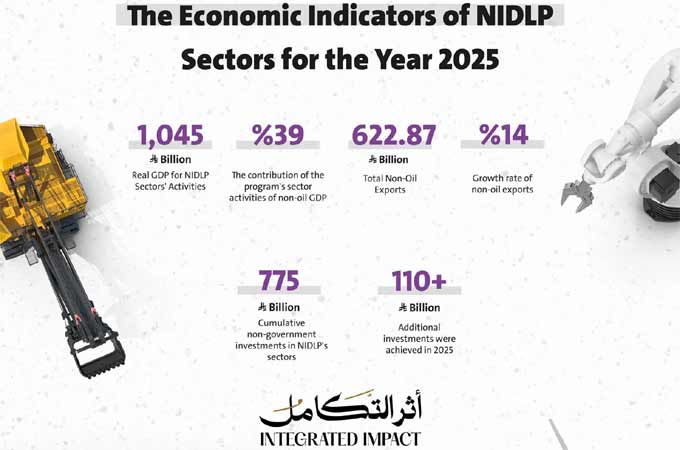
Saudi Arabia's National Industrial Development and Logistics Program (NIDLP) activities contributed SAR1,045 billion to non-oil GDP in 2025, representing 39% of the Kingdom's total non-oil GDP, up from SAR996 billion in 2024, said the program's annual report.
NIDLP represents a national model for integration among strategic sectors by unifying efforts across the energy, mining, industry, and logistics sectors toward shared economic and developmental goals. These goals contribute to diversifying the economic base, enhancing the Kingdom's competitiveness, and supporting the objectives of Saudi Vision 2030, said a Saudi Press Agency report.
The program's 2025 annual report reviews the most prominent economic results and indicators achieved, reflecting the growing impact of integrating the program's related sectors in supporting economic growth, investment, trade, and non-oil exports.
Meanwhile, the contribution of non-oil activities to the Kingdom's total GDP reached 55%.
Additionally, the manufacturing sector recorded growth of 6%, and the electricity, gas, and water sector grew by 5%, while the mining and transport and storage sectors achieved growth rates of 3% and 4%, respectively.
In terms of foreign trade, the total value of non-oil exports reached SAR622.87 billion in 2025, achieving a growth of 14% compared to 2024. Chemical industry exports reached SAR80.3 billion, while machinery and electrical equipment exports reached SAR80.9 billion. Exports of metals and their articles reached SAR25.5 billion, while food and beverage exports reached SAR11.2 billion.
Regarding investment and financing, the value of non-governmental investments completed within the program's sectors reached SAR775 billion. The net cumulative loan approvals from the Saudi Industrial Development Fund (SIDF) reached SAR246 billion, while the cumulative credit facilities provided by the Saudi Export-Import Bank reached SAR116 billion.
The results of sectoral integration manifested in a number of significant achievements across the energy, mining, industry, logistics, future technologies, and local content sectors. In the energy sector, the share of installed capacity from renewable energy sources in the electricity generation mix reached 15.64%, driven by growing solar and wind energy projects. The total capacity tied to renewable energy power purchase agreements exceeded 43 GW, with investments in renewable energy projects nearing SAR102 billion.
The 1,400 MW Najran Solar Energy Project achieved the world's second-lowest cost for solar electricity production at 1.09 US cents per kilowatt-hour, following the Al Shuaibah 1 project, which recorded the world's lowest cost at 1.04 US cents per kilowatt-hour with a capacity of 600 MW. Furthermore, the 1,500 MW Dawadmi Wind Power Project achieved the world's lowest cost for wind electricity production at 1.33 US cents per kilowatt-hour, while the Al-Ghat project recorded the world's second-lowest cost at 1.57 US cents per kilowatt-hour.
In the mining sector, the Kingdom officially entered the top 10 globally in mining investment attractiveness, advancing 94 positions from 2013 and climbing 13 places in a single year. This reflects the significant transformation underway in the sector and the efforts to enhance its investment appeal.
This progress in the mining sector is built on a promising mineral base, with the value of mineral wealth in the Kingdom estimated at around SAR9.4 trillion, reinforcing mining's position as one of the most promising sectors for economic diversification and opening new investment opportunities.
Industrial sector
The industrial sector continued its growth during 2025, with the number of industrial facilities reaching 12,946, while the number of ready-built factories reached 1,511. Cumulative non-governmental investments in economic and industrial cities and special zones reached SAR1,466 billion.
Cumulative sales of local companies operating in military industries reached SAR66.35 billion, while the National Industrial Strategy continues its efforts to localize value chains associated with future industries, including medical supplies, automotive manufacturing, energy-related products, and petrochemicals.
Logistics sector
The logistics sector witnessed continuous development of its infrastructure and operational capabilities, with the number of enabled logistics centres for re-export rising to 24, up from 2 in 2019. Port utilization reached 62%, up from the baseline of 50.2%, and the time required for customs clearance procedures stabilized at 2 hours. The number of containers handled at the Kingdom's ports reached 8.3 million containers during 2025, including 2.2 million transshipment containers, reinforcing the Kingdom's role as a logistics hub connecting regional and global trade.
In a strategic step to enhance connectivity between production centres, markets, and logistics services, operations began on the world's longest railway network, which utilizes ETCS Level 2 technology, boosting transport efficiency and supply chain performance. The network transported more than 30 million tons of goods and carried over 14 million passengers during 2025.
Advanced manufacturing
Regarding the Fourth Industrial Revolution and future technologies, the report highlighted several notable achievements, including the launch of the Advanced Manufacturing and Production Center to enable industrial transformation in the Kingdom, the inclusion of the Fourth Industrial Revolution Center into the Global Lighthouse Network of smart factories, and the establishment of a smart production line for drones. Additionally, the Saudi Space Agency signed an executive agreement with the US Space Agency (NASA) to develop the first Saudi satellite dedicated to studying space weather as part of the Artemis II mission.
The share of local content in government procurement rose to 51.2% by the third quarter of 2025, up from 33.7% in 2020, reflecting the growing contribution of local content to supporting the national economy and strengthening domestic value chains.
Efforts to enhance local content also included adding 449 new national products to the mandatory list for national products during 2025, bringing the total number of products included in the list to 1,670 national products, benefiting 212 factories. The value of tenders linked to the list exceeded SAR50.66 billion, a step that supports the empowerment of national products and enhances their presence in domestic supply chains.