
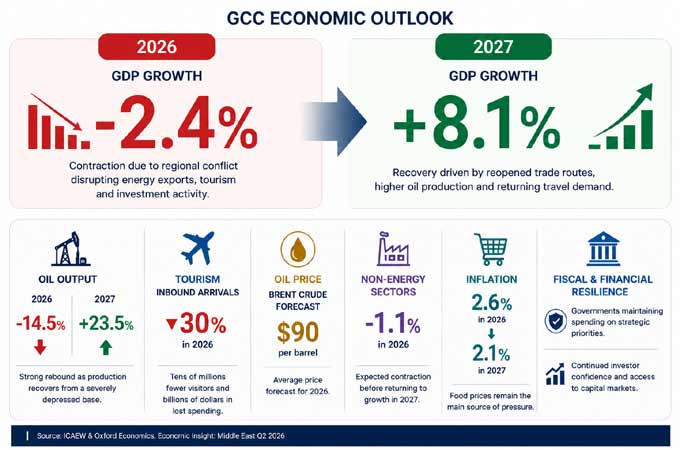
The GDP of GCC states is forecast to grow by 8.1% in 2027 as energy trade routes normalise, travel demand returns, and business confidence rebuilds, says a report.
This follows a projected 2.4% contraction in 2026, as disruption from the ongoing regional conflict weighs on energy exports, tourism, and investor sentiment, according to the latest Economic Insight: Middle East Q2 2026 report, published today by ICAEW and Oxford Economics.
This comes as the US and Iran are set to sign a formal peace agreement on June 19, in line with the report's baseline scenario.
Energy disruption drives near-term contraction
The contraction reflects the scale of disruption to energy production and trade flows. GCC oil sector output is forecast to decline by 14.5% in 2026, the steepest decline in several decades, with a strong 23.5% rebound projected for 2027 as output recovers from a severely depressed base.
Saudi Arabia and Oman are expected to be the least negatively affected GCC economies this year, with both forecast to continue expanding. Saudi Arabia and the UAE have been able to reroute some exports through alternative pipelines, helping cushion the impact relative to other GCC producers. Average Brent crude oil prices are forecast at $90 per barrel for 2026.
Non-oil activity in Saudi Arabia and the UAE appears to be holding up, with May PMI surveys pointing to output growth reaching its strongest level in three months, driven by improved domestic demand. Overall, GCC non-energy sectors are forecast to contract by 1.1% in 2026 before recovering across 2027 and beyond.
Saudi GDP data for Q1 2026 illustrates how the shock has transmitted. Growth slowed to 3% year-on-year, with oil activities falling 6.8% quarter-on-quarter as Strait of Hormuz disruption hit late in the quarter. Non-oil activity edged up 0.3% and government spending rose, pointing to a domestic economy that has remained relatively resilient – the near-term damage concentrated in energy rather than the broader economy.
Tourism and travel face a more sustained period of adjustment
Travel and tourism have been significantly affected, with inbound arrivals to the GCC projected to fall by around 30% in 2026. The report estimates this equates to tens of millions fewer visitors and tens of billions of dollars in lost spending across the region.
Recovery in this sector is expected to take longer than energy, given the sensitivity of travel demand to accessibility and confidence. That said, the region’s established tourism infrastructure, ongoing capacity investment, and targeted tourism strategies provide a strong foundation for recovery once conditions improve. Medium-term confidence in regional tourism growth remains intact.
Fiscal positions and financial markets show resilience
GCC governments are expected to increase spending this year, maintaining commitments to strategic priorities in financial services, technology, and healthcare. Most GCC sovereigns carry relatively modest debt burdens, and funding risks remain contained. Bahrain successfully completed a $1 billion oversubscribed sovereign bond issuance this month, the first from the region since the conflict began, pointing to continued investor confidence in GCC credit.
The UAE central bank’s liquidity management has helped alleviate immediate concerns in domestic markets. The report notes no lasting damage to the region’s strong credit profiles, with Gulf sovereigns and government-affiliated entities expected to return to international debt markets as conditions settle.
Despite recent disruption, inflationary pressures remain relatively contained across the region. GCC CPI inflation is forecast to average 2.6% in 2026, with food prices the main source of upward pressure. Price pressures are expected to be largely transitory, with average inflation easing to 2.1% in 2027 as temporary supply-side factors dissipate.
Hanadi Khalife, Regional Director MEASA, ICAEW, said: “The scale of disruption this year has been significant, and the economic data reflects that clearly. What the data also shows, however, is how the region has adapted. Governments have moved quickly to support activity, alternative trade routes have been activated, and domestic demand has held up better than many expected. The recovery projected for 2027 is substantial, and the conditions for it are already taking shape.”
Azad Zangana, Head of GCC Macroeconomic Analysis at Oxford Economics, added: “The economic damage from the conflict is concentrated and measurable. Energy output has fallen sharply, tourism has been disrupted, and investment activity has slowed. But the recovery in our baseline is rapid. An 8.1% expansion in GCC GDP in 2027 and a 23.5% rebound in oil sector output point to a region that is well positioned to recover quickly as trade routes reopen and travel demand returns.” – TradeArabia News Service