
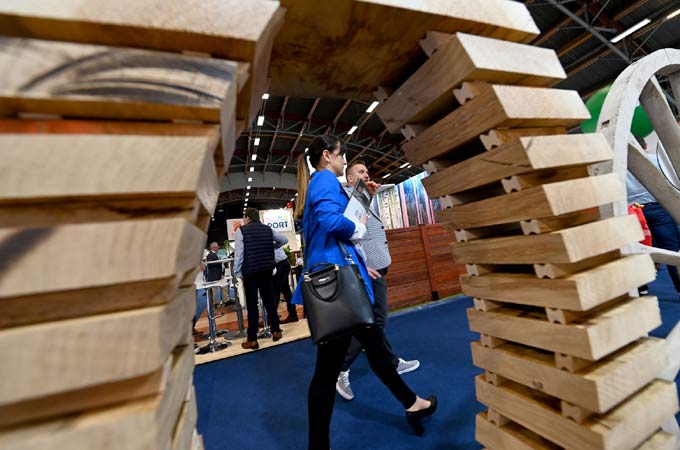
Wood in construction – a pillar of building transition and resilience – is heading towards new market dynamics in 2026.
While the new construction sector is undergoing profound transformations, wood is demonstrating strong regional resilience and is more than ever establishing itself as a material of the future.
Now used across all segments — multi-family housing, commercial buildings, public facilities, and infrastructure — the strongest growth is seen in non-residential buildings and renovation. Off-site construction, reversible buildings, reduced carbon footprint, bio-based materials…
The Carrefour International du Bois (CIB), taking place from June 2 to 4, 2026 in Nantes, France, will explore the new dynamics and latest innovations of a growing market.
For Maxime Baudrand (Wood Construction Prescriber – Fibois Pays de la Loire), the shift is clear: while individual housing is slowing down, the strongest growth is now seen in non-residential buildings and multi-family housing.
“The size of projects is increasing, but the number is decreasing. The wood sector is strong and has a largely underutilized production capacity. The RE2020 regulation is helping to drive the development of wood. Companies are ready to absorb a massive demand, provided materials are combined and the sector moves toward standardization for the new-build market.”
Towards new dynamics for 2026
In construction, the traditional approach — characterised by decisions made progressively on-site — is shifting toward more anticipatory design. For Karine Bouhier, Co-Director of LCA Construction, this transformation is driven by off-site construction, which not only optimizes timelines and saves time, but also reduces on-site waste.
“We are now entering an era of frugality, where the goal is to ‘do better with less,’ prioritizing building reversibility and the reuse of existing materials rather than systematic demolition. In her view, the challenge in the coming years no longer lies in ‘all-wood’ construction, but in using the material in the right proportion—particularly in renovation and non-residential projects. Let’s prioritize uses by incorporating more wood overall, but less per building.”
Bio-based materials at the heart of CIB
For its next edition, the Carrefour International du Bois 2026 is taking a new step by highlighting bio-based materials with a dedicated space at the heart of the exhibition.
Designed as a true hub for inspiration and demonstration, this area will showcase concrete solutions integrating wood, straw, hemp, and natural insulation, in response to the decarbonization challenges of the construction sector.
The programme will include live demonstrations, presentations of exemplary projects, models, feedback sessions, and expert talks to illustrate the growing importance of these materials in construction and renovation projects.
“By bringing together project owners, specifiers, developers, and companies, this space aims to accelerate the adoption of bio-based materials and support stakeholders in scaling up their use. It is an initiative aligned with regulatory developments and market expectations, where environmental performance and construction innovation are becoming inseparable,” emphasises Géraldine Cesbron, General Commissioner of the event.
Key figures
According to the 2025 National Wood Construction Survey
• 1,905 specialised companies employ nearly 29,000 employees
• The share of wood construction in the housing market reached 6.6% in 2024, compared to 6.2% in 2022
• 36% of companies plan to invest over the next two years
• 48% of builders are considering hiring to anticipate the 2026 recovery
• Wood construction companies are better structured than the average in the building sector, with an average workforce of 15 employees (compared to 3.4 in the general construction sector) and a more highly skilled workforce
• Auvergne-Rhône-Alpes remains the leader (€365M in revenue), followed by Pays de la Loire (€300M) and Grand Est (€270M).
Focus on two emblematic timber structures
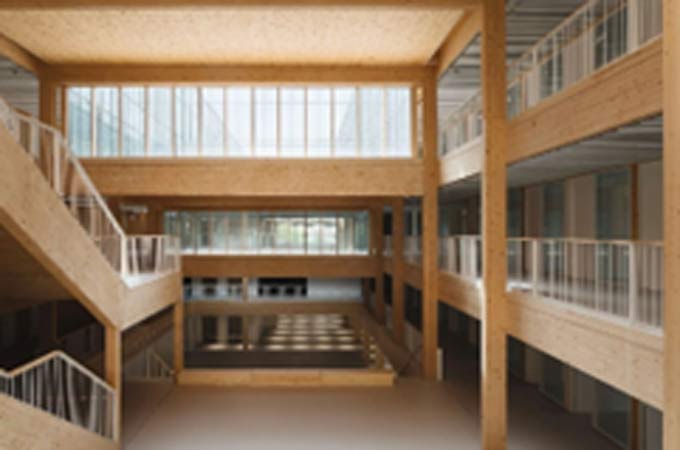
In Pamplona, the Faculty of Health Sciences at the Universidad Pública de Navarra is a benchmark in sustainable construction. Designed by VArquitectos and Bryaxis Arquitectos, and built by the ACR-Guillén consortium, the faculty made wood its main structural material.
The above-ground structure combines glulam beams and columns with Sylva™ CLT floor slabs, making it the largest timber building in Navarre.
Spanning over 13,500 sq m, it includes 22 classrooms, around a dozen laboratories, one auditorium, and flexible spaces designed to evolve with academic needs.
In total, 1,500 students, teachers, and researchers will be able to work in an environment designed for the future.
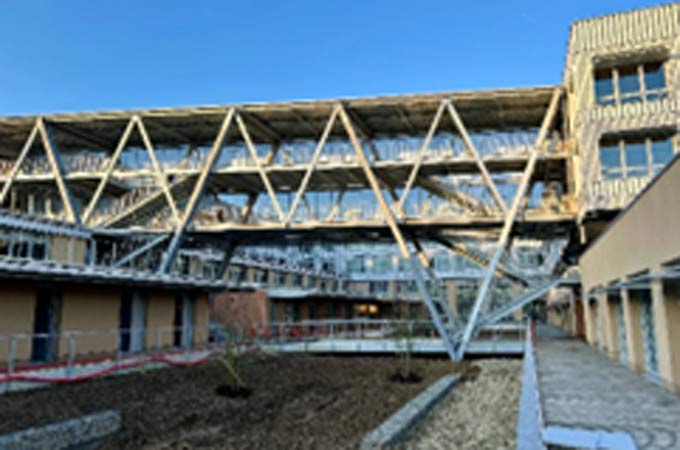
The future Lycée Saint-Philbert-de-Grand-Lieu, designed by the Forma6 studio, is the largest first-category public access building (ERP) in France, entirely insulated with straw and hemp wool.
The building focuses on optimising insulation and solar protection, as well as applying the Avoid-Reduce-Compensate (ERC) approach to limit the project’s impact on land use (a vertical 4-storey building with one wing built along the property boundary).
The building received the HQE Sustainable Building certification in 2023.