
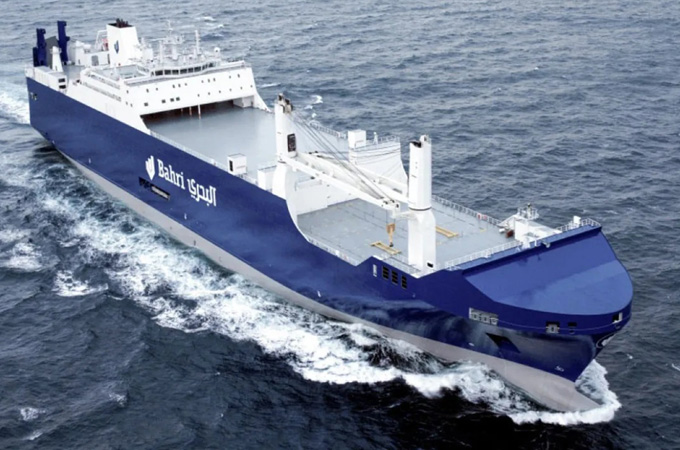
Saudi Arabia's National Shipping Company Bahri has delivered solid results for the first quarter of 2026 with a 129% growth in its revenue which soared to SAR4.96 billion ($1.32 billion), driven primarily by a sharp uplift in Bahri Oil and supported by higher contributions across all other business units, while its net profit surged four-fold to hit SAR2.15 billion ($572 million).
Announcing its results for the three-month period ended March 31, 2026, Bahri said the revenue increase in Bahri Oil was mainly attributable to a substantial rise in freight rates, supported by improving supply-demand dynamics in the crude oil transportation market, the escalation of regional disruption, the benefit of its expanded fleet, and increased voyage charter-in activity to meet higher customer requirements.
Group ebitda rose 137% year-on-year to SAR2.84 billion, lifting ebitda margin to 57% from 55% in Q1 2025. The ebitda growth was led by Bahri Oil, reflecting higher revenue and the stronger earnings environment during the quarter.
This was further supported by ebitda growth in Bahri Chemicals & Products and Bahri Dry Bulk, which benefited from firmer freight rates in the clean petroleum products and dry bulk markets, respectively.
Bahri Marine Services also contributed to ebitda growth, reflecting a larger operating base compared with Q1 2025. These gains were partly offset by lower income from associated company Petredec Group and a decline in Bahri Integrated Logistics’ ebitda attributable to a one-off reversal of prior-year cost accruals in Q1 2025.
Bahri, the kingdom’s leading shipping and logistics provider, said the net profit attributable to Bahri shareholders reached SAR2.15 billion, more than four times the SAR533 million recorded in Q1 2025, reflecting the strong rise in operating profitability during the quarter.
Compared with Q4 2025, Bahri’s revenue increased by 52%, while ebitda and net profit rose by 69% and 120%, respectively, driven mainly by Bahri Oil, alongside stronger results from Chemicals & Products and Marine Services.
On the group's impressive performance, CEO Eng. Ahmed Ali Al Subaey said: "Bahri delivered an exceptionally strong first quarter, supported by higher freight rates, the benefit of our larger fleet, and increased charter-in activity to meet higher cargo requirements. Just as importantly, we remained focused on delivering safe, dependable service to our customers while navigating through a more complex and volatile environment."
"Despite disruption to maritime traffic through the Strait of Hormuz and heightened regional uncertainty, Bahri remained resilient throughout the quarter, with all of our vessels commercially deployed. Our people and vessels remained safe, and our fleet continued to operate and serve our customers reliably, supported by the dedication of our crews and onshore teams," he stated.
"Our long-standing global partnerships also remained a source of strength, providing demand visibility and commercial stability while helping us respond proactively to evolving trade flows, shipping routes, and customer requirements," he added.
The top Saudi shipper said it continues to monitor developments in the region closely and assess their broader implications for the operating environment.
"Our priority remains the safety of our people and assets, and the continuity of our operations. Amid heightened uncertainty, we remain committed to leveraging our scale and integrated capabilities to support the flow of essential trade and enable economic activity in the kingdom and across global markets, fulfilling Bahri’s role as a responsible participant in the global supply chain," he noted.
Bahri, he said, had generated net operating cash flow of SAR1.34 billion in Q1, up 174% year-on-year, supported by the strength in earnings during the quarter.
Capital expenditure in the quarter was limited to SAR68 million, mainly for vessel maintenance.
Bahri said it maintained a fleet of 104 owned vessels and 107 operated vessels overall, and reported no fatalities or oil spills during the period.
The company’s net debt-to-ebitda ratio improved to 1.14 times, reflecting stronger earnings and cash generation.
Looking ahead, Bahri said it continues to monitor regional developments and remains focused on safety and operational continuity, while progressing its fleet expansion programme, which includes 10 vessels scheduled for delivery through 2029.