
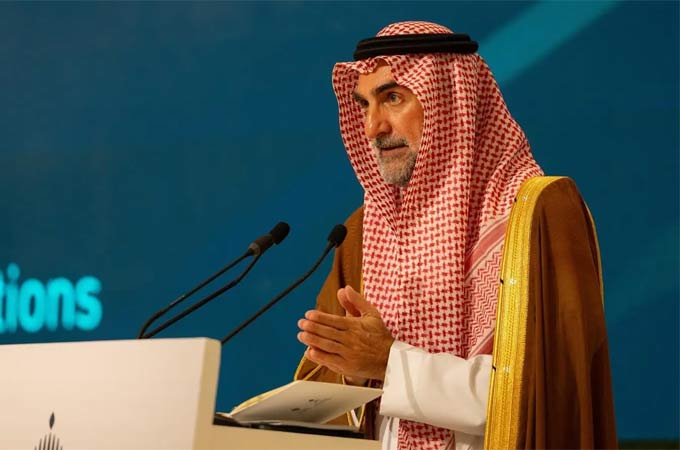
 PIF Governor Yasir Al-Rumayyan. Image courtesy: SPA
One of the key investment areas under Saudi Public Investment fund's new 2026-2030 strategy is the Advanced Manufacturing and Innovation ecosystem.
This aims to build new export-oriented sectors that will anchor the Saudi economy of the future through the development of integrated industrial clusters in artificial intelligence, automotive, pharmaceuticals, and aviation, space and defence, amongst others, said PIF Governor Yasir Al-Rumayyan.
It will raise the nation’s manufacturing capabilities, create high‑value export‑ready products, boost productivity and generate quality jobs. Key targets include expanding data‑center capacity to 3,000 MW (PIF is committing 1,800 MW), contributing up to SAR7 billion to domestic pharmaceutical manufacturing, and producing 285,000 vehicles toward the national goal of 500,000 units by 2030.
Representative companies are HUMAIN (AI solutions), CEER (electric vehicles), Nupco (medical supplies and pharma) and SAMI (military industries).
Industrials and logistics
He also highlighted the Industrials and Logistics ecosystem, which supports the development of the Kingdom’s core infrastructure, strengthening logistics networks, basic industries and mining output, with PIF improving logistics‑infrastructure quality to raise Saudi Arabia’s Logistics Performance Index and meet container‑throughput targets.
At the same time, mining production will be expanded to raise the sector’s contribution to GDP. The ecosystem’s principal assets include Ma’aden, Saudi Iron & Steel (Hadeed) and Bahri.
Clean energy
In the Clean Energy, Water, and Renewables Infrastructure ecosystem, Al-Rumayyan underscored cementing Saudi Arabia’s position as a global energy leader and a benchmark for sustainable power. Its primary purpose is to accelerate the development of renewable‑energy sources and diversify the Kingdom’s energy export portfolio. The ecosystem aims to raise renewable‑energy generation capacity to 100 GW, with PIF targeting 44.5 GW in total. Key partners include ACWA, Saudi Electricity Company, Marafiq, Energy Efficiency & Conservation Company (Tarshid), and SIRC Recycling.
Al-Rumayyan revealed that between 2021 and 2025, the PIF deployed approximately SAR750 billion ($199.92 billion) in new domestic projects, representing around 70% of its total investments, while consistently securing an annual average total portfolio return exceeding 7% since 2017.