
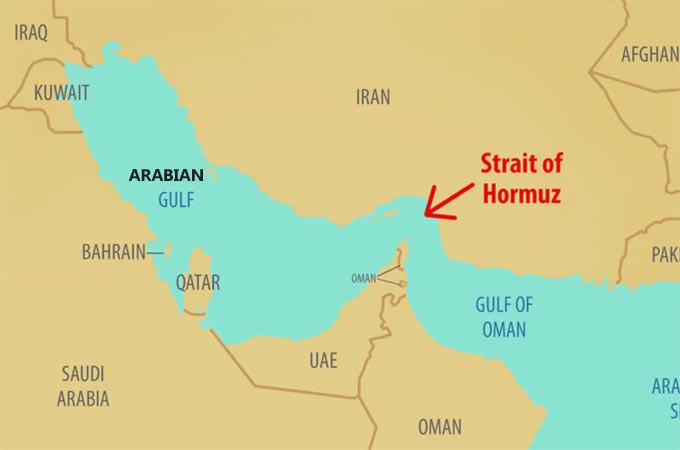
Iran's Revolutionary Guards warned on Saturday that no vessel would be allowed to pass through the Strait of Hormuz, a chokepoint through which nearly a fifth of the world’s oil supply passes.
An official from the European Union's naval mission Aspides said vessels in the region had received VHF transmissions from Iran's Revolutionary Guards stating that "no ship is allowed to pass the Strait of Hormuz", Reuters reported on Sunday.
Several tanker owners, oil majors and trading houses have suspended crude oil, fuel and liquefied natural gas shipments via the Strait of Hormuz after the US. and Israel attacked Iran and Tehran said it had closed navigation, trading sources said.
"Our ships will stay put for several days," one top executive at a major trading desk said. Satellite images from tanker trackers showed vessels backed up next to big ports, such as Fujairah in the United Arab Emirates, and not moving through Hormuz.
The Strait of Hormuz connects the Gulf's largest oil producers - including Saudi Arabia, Iran, Iraq and the United Arab Emirates - to the Gulf of Oman and the Arabian Sea. Around 20 million barrels per day of crude and refined products move through the narrow shipping lane between Iran and Oman, accounting for almost one-fifth of global oil consumption.
A disruption there would ripple across Asia's largest economies. It would also halt Iran's own exports, depriving Tehran of critical revenues - one reason the waterway has never been fully blocked despite repeated threats.
OPEC may hike output
Meanwhile, OPEC+ may consider a larger-than-planned output increase of 411,000 barrels per day at a meeting on Sunday, Reuters said quoting two sources close to the talks.
This follows Saudi Arabia and the UAE raising exports in anticipation of possible disruption to oil markets from US-Israeli strikes on Iran carried out on Saturday.
Eight members of OPEC+, which groups the Organization of the Petroleum Exporting Countries and allies - Saudi Arabia, Russia, the UAE, Kazakhstan, Kuwait, Iraq, Algeria and Oman - were already scheduled to meet on Sunday at 1100 GMT.
Despite expectations that oversupply would weigh on the market, oil prices have risen this year on fears that a conflict between Iran and the US would disrupt Middle East supply through the Strait of Hormuz. Oil hit $73 a barrel on Friday, the highest level since July.
Delegates had earlier said the eight countries would likely agree to a modest increase of 137,000 barrels per day in oil output for April, as the group readies for summer demand, led by the US driving season, and as crude prices had already risen on expectations of a US attack on Iran.