
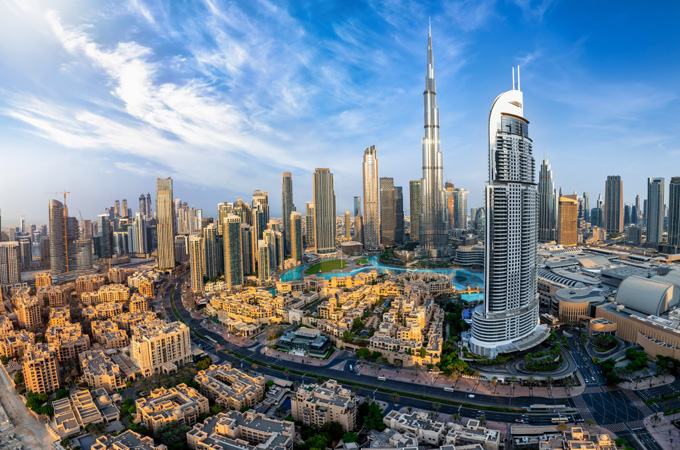
UAE's real estate market ended 2025 on a high note thanks to the strong performance across its commercial, residential, hospitality, retail and industrial sectors, according to CBRE Middle East, a global leader in commercial real estate services.
The country’s real estate markets have continued to expand at pace through the final quarter of the year, supported by resilient non‑oil economic activity, strong population growth, and sustained domestic and international investment appetite, stated CBRE in its report.
The UAE's economic outlook for 2025 and 2026 anticipates a measured pace of growth, driven primarily by the robust expansion of non-oil sectors.
This is supported by significant foreign investment, a continually improving business environment, and positive trends in the labour market, it stated.
Despite a slight moderation of the UAE’s macroeconomic forecasts for H2 2025 and for 2026 due to weaker‑than‑expected oil sector performance, growth across the commercial, residential, hospitality, retail, and industrial sectors remained robust, highlighting the depth and diversification of the national economy, it added.
On the residential sector, CBRE said Abu Dhabi delivered one of its strongest years on record, with transactions surging 50% and values rising 61% versus 2024. Off‑plan sales dominated activity and contributed to the exceptional price growth, with overall residential values up nearly 32% year‑on‑year.
Apartments increased by close to 35%, outperforming villas, which grew by nearly 14%. The rental market followed a similar trend, with average rents rising 22% annually. Persistently tight supply conditions and structural demand expansion continue to underpin the capital’s residential momentum heading into 2026, it stated.
Meanwhile, its neighbouring emirate Dubai sustained its upward trajectory through the end of 2025, supported by healthy demand fundamentals, albeit against a very significant pipeline of future supply.
While rental growth has cleared moderated and plateaued on a quarterly basis, annual rents were still up by around 6%, with apartments increasing 7% and villas 1%. Sales prices, meanwhile, continued to grow, posting a 13% year‑on‑year increase, reflecting solid buyer activity and robust investor sentiment.
However, performance levels have varied across communities, with emerging areas such as Dubai Silicon Oasis and Town Square significantly outperforming more mature districts.
Transaction activity also reached new highs, with over 206,000 residential transactions recorded in 2025, up 18% year‑on‑year, and with off‑plan sales representing nearly three‑quarters of all activity, according to CBRE.
While the hydrocarbon sector is experiencing a period of adjustment, its overall impact is moderate. Inflation remains under control, and the US Federal Reserve's anticipated rate cuts are expected to further stimulate activity in the real estate sector, it added.
On the office sector, CBRE said its key markets of Dubai and Abu Dhabi continued to outperform, with rental growth accelerating in both emirates as occupancy levels climbed to record highs.
In Dubai, average rents rose by 18% year‑on‑year, driven by a sharp imbalance between available supply and rapidly expanding occupier requirements. Average occupancy reached nearly 95%, supported by limited new completions and growing interest from both regional and international firms.
Momentum behind new strata office launches has continued, with IRTH Group’s most recent project maintaining activity across the Business Bay sub-market, , while upcoming completions from single landlord properties across key freezones continue to attract significant pre‑leasing interest, underscoring ongoing supply constraints, it stated.
Abu Dhabi’s office market recorded an equally impressive performance, with average rents increasing 12% year‑on‑year, whilst average occupancy rates have reached close to 98%.
Appetite remains particularly strong for the ADGM Freezone, where demand continues to outstrip available Grade A supply.
However, a series of new development initiatives, including the Mubadala-Aldar joint venture at Maryah East and continued progress on One Maryah Place, signal developer’s strong confidence in the long‑term prospects of the capital’s commercial sector, it added.
On the retail sector, the performance remained steady, supported by strong population growth, sustained tourism activity, and rising consumer spending.
With occupancy levels reaching 98% in Dubai and 95% in Abu Dhabi, landlords continued to hold significant negotiating leverage, keeping rental rates elevated across prime assets. Dubai’s retail rents rose close to 6% year‑on‑year, while Abu Dhabi posted a more moderate 2% increase as the market continued to stabilize.
Limited new supply in the immediate term is likely to preserve current market dynamics, said CBRE in its report.
On the UAE's industrial and logistics sector, CBE said it recorded another year of rapid expansion, driven by strong occupier demand, growing non‑oil exports, and limited availability of quality space.
In Dubai, warehousing rents rose 13% year‑on‑year, reflecting persistent undersupply and rising demand from e‑commerce, manufacturing, and third‑party logistics operators.
Major projects such as Terralogix in Warsan and Brookfield’s new Grade A development are expected to alleviate some pressure, though not enough to fully rebalance the market in the near term.
Abu Dhabi’s industrial landscape also strengthened, supported by rising exports, expanded SME activity, and the ongoing implementation of the Abu Dhabi Industrial Strategy 2031, which aims to double the sector’s contribution to GDP. Industrial rents in Kezad Al Ma’moura A have surged more than 50% over the past two years, demonstrating the depth of occupier demand and tightness of available supply.
Matthew Green, Head of Research at CBRE Mena, said: "The UAE real estate market continues to demonstrate remarkable resilience across all major sectors. Demand fundamentals remain exceptionally strong, supported by ongoing economic diversification, robust population growth, and rising investor confidence."
"Supply constraints are a common theme across office, industrial, and select residential sub‑markets, and this imbalance will continue to shape performance through 2026. As the UAE advances its long‑term development strategies, the real estate sector is increasingly positioned as a key pillar of sustainable economic expansion," he added.-TradeArabia News Service